Google and DeepMind Introduce Dream-RSI: A Recursive Self-Improvement Loop for AI Agents
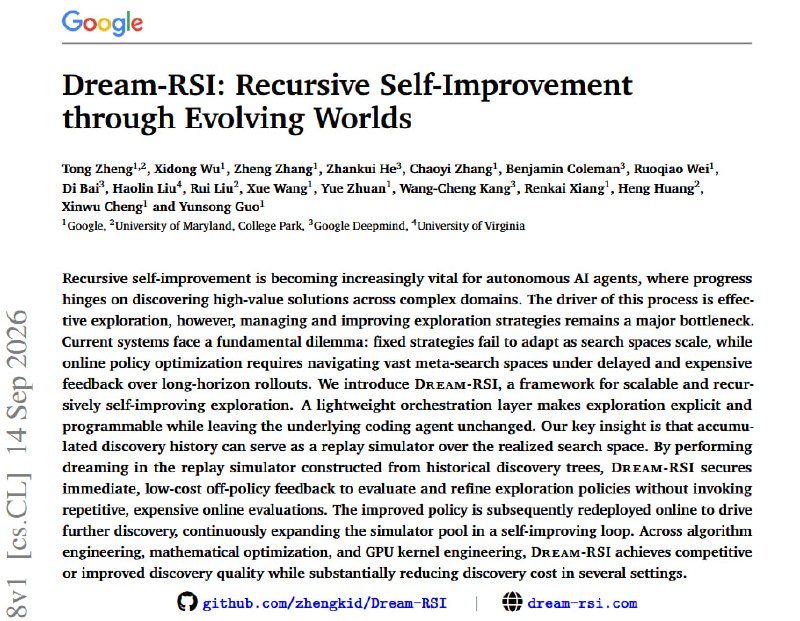
Researchers from Google and DeepMind introduced Dream-RSI, a system in which an AI agent improves how it explores tasks. To do this, the agent replays its previous attempts, cheaply tests thousands of alternative strategies, and then uses a more successful strategy in the next round.
In tasks involving algorithm development, mathematical optimization, and GPU-kernel creation, the system preserved or improved the quality of results while significantly reducing search cost. In one experiment, the number of agent calls was reduced by a factor of 162.
Importantly, the system improves the exploration strategy itself, not the weights of the model.
The paper is available on arXiv: https://arxiv.org/pdf/2609.14858.
Why it matters
AnalysisIt demonstrates a path to more effective AI by optimizing the research process rather than only scaling model weights. This could make agentic tasks cheaper and faster for complex engineering and mathematical problems.
Discuss in community
Share your questions and insights with developers
Related in Ecosystem
Practical guides, core terminology, and agent skills
Claude Code Projects: How a Single AI Orchestrates a Team of Autonomous Agents
A deep dive into Claude Code Projects: Coordinator and Threads architecture, parallel branches, shared memory via MEMORY.md, and cloud agent management.
AI Agents (Autonomous Agents)
Software systems based on LLMs that can autonomously perceive the state of the environment, decompose complex goals, invoke external tools, and iteratively correct their own mistakes.
Google Gemini Pro (Model with Infinite Context)
The flagship working model from Google DeepMind featuring a record context window of over 2 million tokens. Capable of analyzing entire books, lengthy videos, and massive codebases in a single query.
OpenAI agents found 948 vulnerabilities in the Linux kernel
OpenAI researchers used an unreleased cybermodel and an autonomous pipeline to identify, reproduce, and patch Linux kernel flaws, confirming 948 privilege-escalation vulnerabilities.