Ember-1: Fine-tuning Kimi K3 cuts reasoning length by 40%
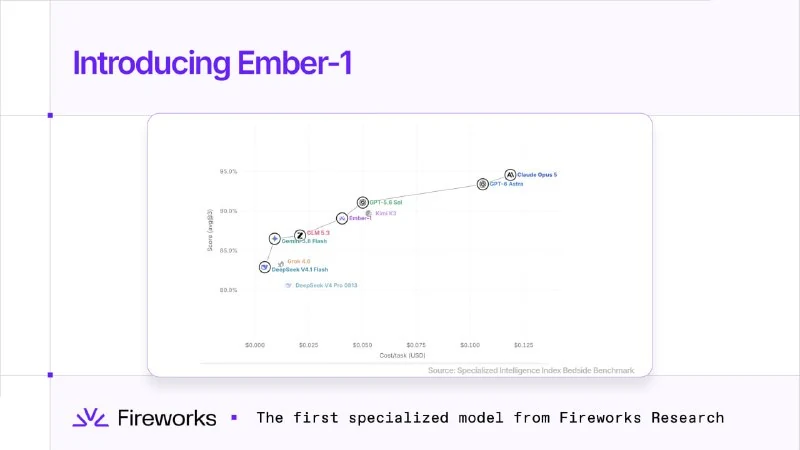
A research team fine-tuned Kimi K3 so its reasoning traces are about 40% shorter without losing quality. Ember-1 is now available in Cline.
Ember-1 is being actively discussed on Hacker News.
A research team fine-tuned Kimi K3 so its reasoning traces are about 40% shorter.
Quality remained the same, while the model became roughly 40% faster and cheaper.
This is a good example of how it makes sense to build frontier LLMs today. If you have a few tens of millions of dollars, you do not necessarily need to train a new model from scratch. You can take an already strong existing model and invest that budget in fine-tuning it.
Ember-1 is already available in Cline, including the new desktop app.
Why it matters
AnalysisThis case shows that frontier LLMs can be improved by fine-tuning strong existing models instead of training from scratch, delivering faster and cheaper inference.
Discuss in community
Share your questions and insights with developers
Related in Ecosystem
Practical guides, core terminology, and agent skills
RAG vs Fine-Tuning (The Eternal Dilemma of AI Implementation)
A fundamental architectural choice for businesses. RAG (Retrieval-Augmented Generation) versus Fine-Tuning (modifying model weights through additional training). Criteria for choosing between factual relevance and specific behavioral style.
Fine-Tuning Basics
The process of adapting a pre-trained large model to a specialized task or style using a small, high-quality dataset (Supervised Fine-Tuning, SFT). This enables training AI on medical terminology, corporate tone, or specific code formatting within hours.
Part I. AI Agent Architecture: The Foundations
The eleven foundational building blocks of modern autonomous agents: model taxonomy, the agentic runtime loop, advanced prompting, distillation, skills architecture, memory systems, function calling, and FinOps.
Part II. AI Agent Architecture: From Model to Memory and Tools
A deep engineering dive: tokenization, KV-cache, sampling determinism, the training stack, quantization, context engineering, the safety stack, production RAG, ReAct, and multi-agent swarm systems.