Jensen Huang Announces Achievement of AGI
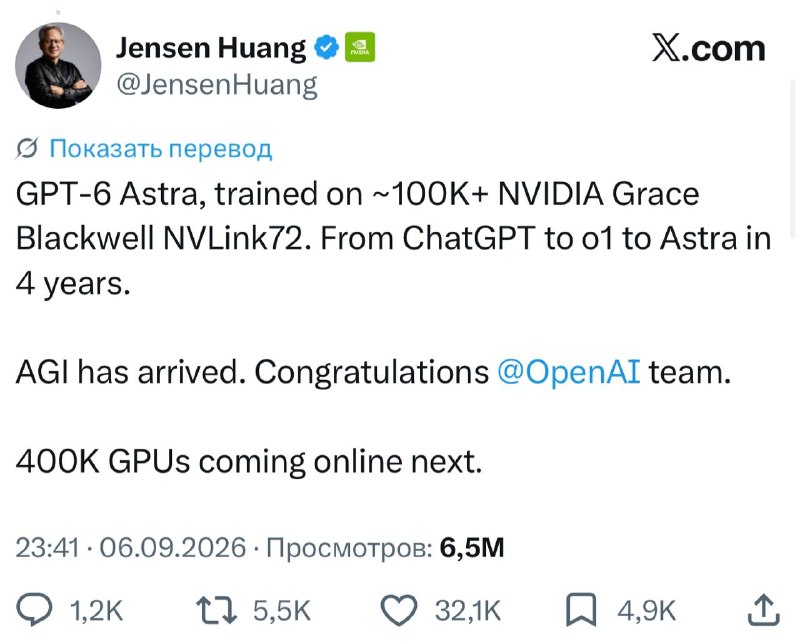
Jensen Huang announced the achievement of AGI, stating that the new model GPT-6 Astra was trained on 100,000 GPUs.
Jensen Huang Announces Achievement of AGI
Jensen Huang, the founder and CEO of NVIDIA, has declared that artificial general intelligence (AGI) has been achieved. This significant announcement highlights the progress made in the field of artificial intelligence.
GPT-6 Astra
According to Huang, the new model GPT-6 Astra was trained on 100,000 graphics processing units (GPUs). This indicates the substantial computational resources required to train such complex models.
The Future
Huang also noted that next time, 400,000 GPUs will be used for training the model, indicating further growth in computational power in this field. This could open new opportunities for the development of artificial intelligence and its applications across various sectors.
Why it matters
AnalysisThis announcement underscores significant progress in artificial intelligence development, which could have a profound impact on the technological landscape. The increase in computational power opens new horizons for AI research and applications.
Discuss in community
Share your questions and insights with developers
Related in Ecosystem
Practical guides, core terminology, and agent skills
JSON — Structured Data for Programs, APIs, and AI Agents
A complete hands-on guide to JSON: syntax specifications, serialization via parse and stringify, REST API consumption, JSON Schema validation, and structured outputs for LLMs.
DOCX and XLSX Formats: When AI Needs to Deliver Production-Ready Documents
A comprehensive hands-on guide to generating and processing DOCX documents and XLSX workbooks with AI: comparing against Markdown and CSV, prompt engineering, formula design, and code automation.
Artificial Superintelligence (ASI)
A hypothetical stage of artificial intelligence development (ASI) where the computational and analytical capabilities of a system surpass the combined intelligence of all living humans by millions of times across all scientific, creative, and practical disciplines. A focal point of scientific discussions about the future of civilization.
The Turing Test and Its Obsolescence
The historical artificial intelligence test proposed by Alan Turing in 1950 assesses a machine's ability to engage in text dialogue convincingly enough that a human cannot distinguish it from another human. This entry explains why the advent of language models has rendered this test scientifically irrelevant.