OpenAI's Jalapeño Chip Outperforms Nvidia in Inference
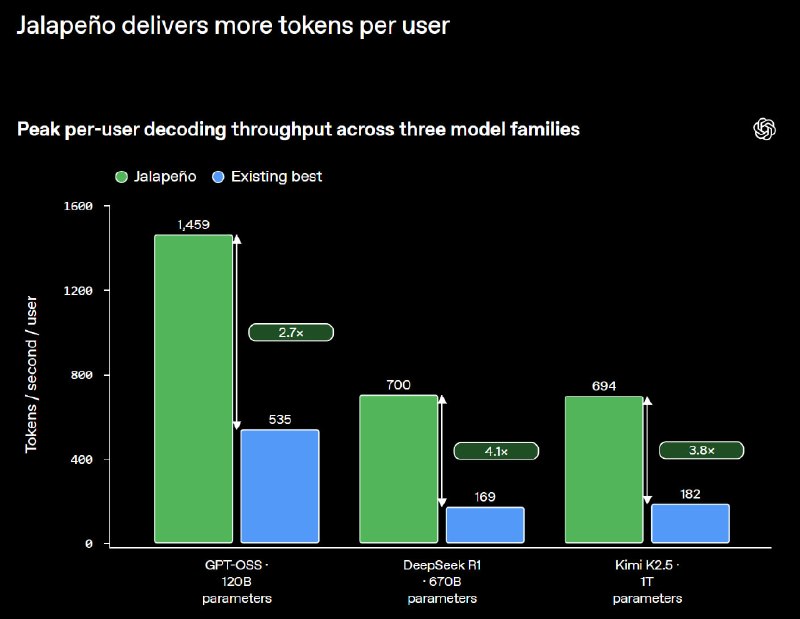
OpenAI has unveiled its new Jalapeño chip, showcasing impressive inference capabilities that surpass competitors, including Nvidia. The rapid development timeline highlights the team's potential.
OpenAI's Jalapeño Chip Outperforms Nvidia in Inference
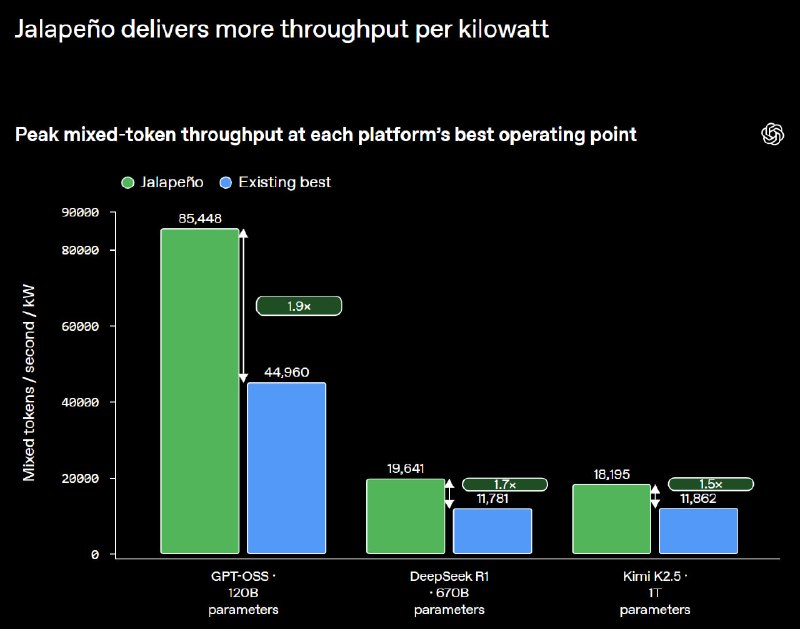
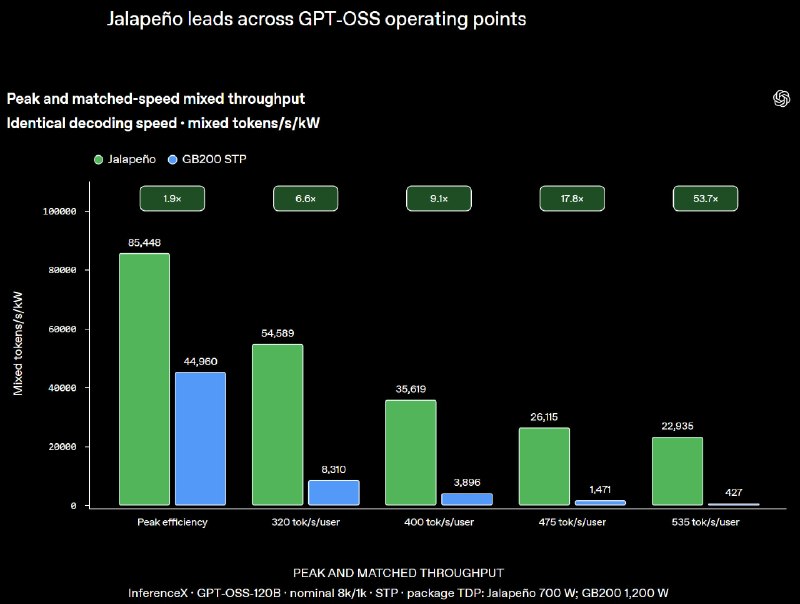
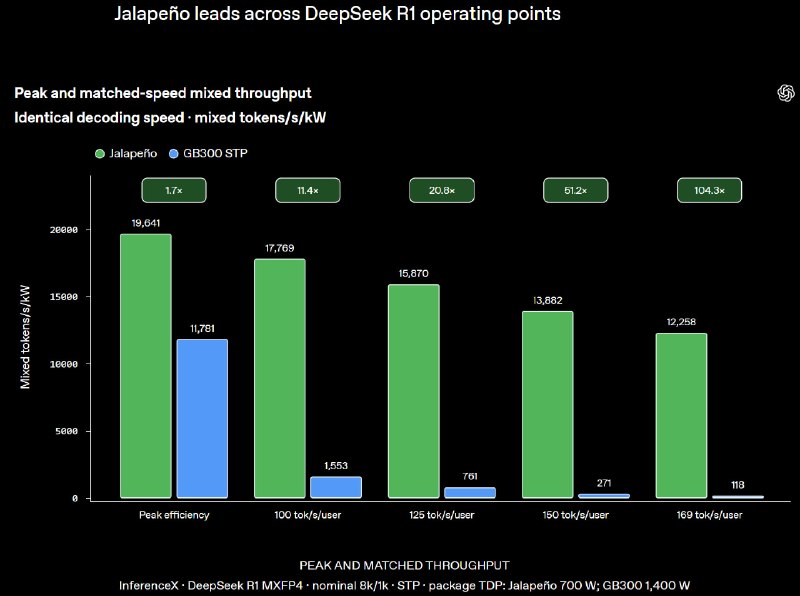
OpenAI has published a blog post detailing their testing of the Jalapeño chip on InferenceX from SemiAnalysis and a lecture at Hot Chips. Each chip features 216 gigabytes of HBM4 and can deliver up to 13.4 PFLOP/s in mxfp4. Compared to the GB200/GB300, it outputs significantly more tokens per second at peak performance and up to 2x tokens per watt at maximum throughput, with the gap widening as tokens per second per user increase.
However, the real competitor to Jalapeño is Nvidia's new generation chip, Rubin. Benchmark results for Rubin are currently limited, but based on the published data, Jalapeño appears to outperform it as well. Notably, Rubin's benchmarks utilize speculative decoding, unlike Jalapeño, which still has much room for optimization.
In summary, OpenAI now has a very capable chip that rivals the best Nvidia chips in inference. What’s most striking is the speed of development: the chip was initiated in October 2024, the first version went into production in November 2025, with the first chips ready by May 2026. In less than three months, the chip's software is already at a level that allows it to compete with the best in the industry. Interestingly, Jalapeño was developed by a tiny team of just ~30 people. Mass deployment of Jalapeño is expected next year.
Why it matters
AnalysisThis chip could significantly impact the AI market by offering high performance with reduced energy costs. The rapid development also showcases OpenAI's innovative potential.
Discuss in community
Share your questions and insights with developers
Related in Ecosystem
Practical guides, core terminology, and agent skills
Four Resume Tips from OpenAI’s Head of Applied AI Development
Wulfie Bain, OpenAI’s head of applied AI development, shared four resume rules: keep it short, remove irrelevant details, highlight outcomes, and lead with the strongest achievements.
AI Radar: GPT-6.1 Terra, Gemini 4 Carbon, Mistral Large 4 and OpenAI/Anthropic pricing changes
A roundup of recent AI news: new LLM releases, OpenAI and Anthropic subscription changes, world models, video generation, and research updates.
Nvidia's Monopoly and the CUDA Platform
An analysis of Nvidia's technological and economic dominance in the AI market. The CUDA (Compute Unified Device Architecture) platform, created in 2006, transformed ordinary gaming GPUs into the planet's primary computational tool, making it difficult for competitors like AMD and Intel to break this monopoly.
OpenAI GPT (Flagship Models of the GPT Series)
The primary universal line of large language models from OpenAI (GPT-4, GPT-4o). Optimized for complex text analysis, programming, creativity, and daily intellectual tasks.