Harvard Researcher Proposes Finding Scientific Problems Shaped for Claude
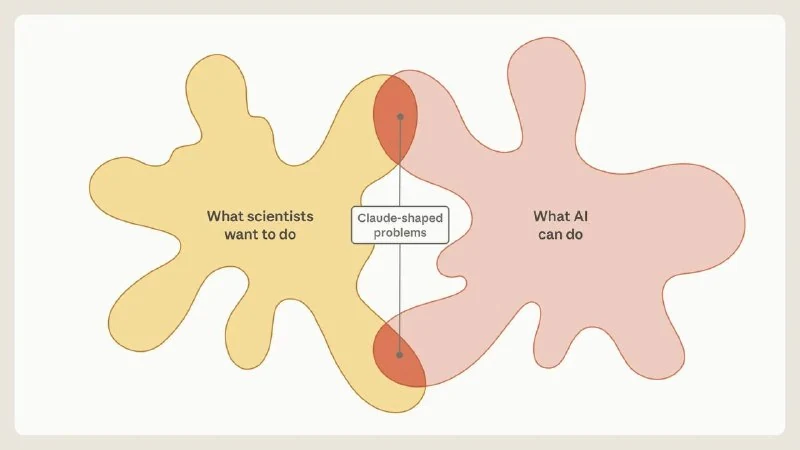
The Claude-shaped problems approach uses LLM strengths to find transferable mathematical methods across scientific fields, while requiring expert judgment about scientific value.
Matthew Schwartz, who previously used Claude to write a full theoretical physics paper in two weeks, continued the experiment. This time, he decided not to force the model to act like a scientist, but to look for scientific problems that fit the strengths of modern LLMs.
He calls them Claude-shaped problems. The idea is that very similar mathematical structures keep appearing across different scientific fields, yet researchers in one area may simply not know that the method they need has existed for a long time in another. LLMs are especially good at finding such connections across a large amount of scattered literature.
For this purpose, Schwartz and Claude built BootLoops, a set of tools for exact mathematical computations. It was originally created for theoretical physics, but Claude began finding practically the same problems in ecology, genetics, economics, linguistics, and other fields.
For example, in ecology the model found an equation from biodiversity theory that had not been efficiently computable on large datasets for about 20 years, and solved it using methods from mathematical physics. In population genetics, Claude found a way to compute an integral exactly, something that had been approximated for about 30 years. This allowed researchers to test a DNA recombination model on a huge genetic dataset and detect traces of gene conversion that were previously hard to isolate.
However, an important problem emerged: Claude was quite good at finding technically correct results, but poor at understanding whether they were actually interesting for a given science. Schwartz repeatedly brought such findings to domain experts and received roughly the same response: technically impressive, scientifically not very interesting.
The workflow therefore changed. Claude searches for connections between fields, writes code, performs computations, and explores hypotheses, while the domain scientist decides which question is genuinely worth asking. This way, a result that initially seemed uninteresting in ecology became, with an expert, a new model of forest dynamics, and a calculation in genetics led to an analysis of billions of mutation pairs.
Schwartz believes that this is where modern AI models can already noticeably accelerate science. A vast layer of scientific problems can be solved not by inventing a new method, but by transferring an existing method from another field.
Why it matters
AnalysisIt shows LLMs can accelerate science by connecting distant domains, but human experts still decide which results are meaningful.
Discuss in community
Share your questions and insights with developers
Related in Ecosystem
Practical guides, core terminology, and agent skills
Anthropic mathematician claims possible proof of Riemann hypothesis with Claude
Levent Alpoge says collaborative work with Claude may have led to a proof of the Riemann hypothesis.
Anthropic Introduces Claude Platform OAuth for Connecting Organizations Without API Keys
Claude Platform OAuth lets users connect their Claude organization via OAuth, pay for API usage directly, and revoke access at any time.
Computer Use via AI
Anthropic's technology (introduced in Claude 3.5 Sonnet) enables neural networks to control operating systems like a human: taking screenshots, analyzing window coordinates, moving the mouse cursor, clicking buttons, and entering text without using specialized APIs.
Constitutional AI (RLAIF)
A behavior alignment method developed by Anthropic (creators of Claude). Instead of relying on millions of hours of human labor, the model critiques and corrects its own responses based on a clear set of ethical principles ('Constitution').