AI Research Automation: Challenges and Threats
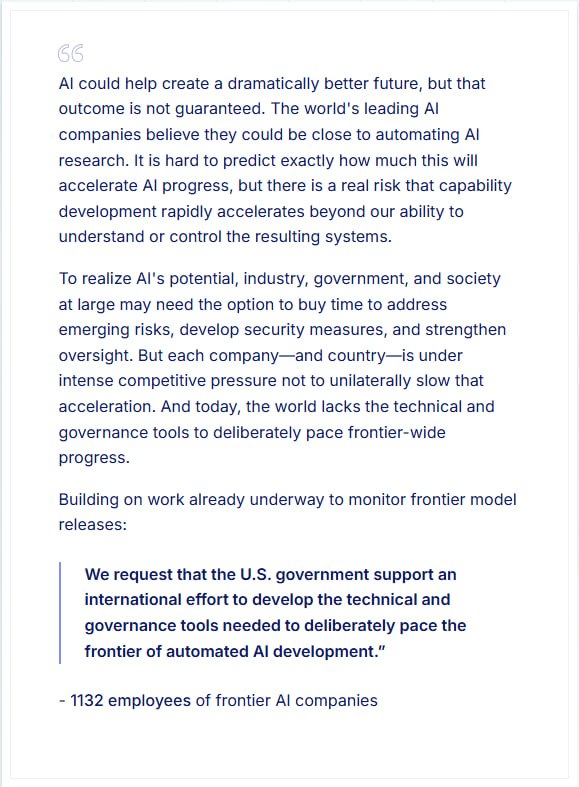
Prominent researchers from leading AI labs warn about the risks of research automation that could lead to uncontrollable technological progress.
AI Research Automation: Challenges and Threats
Just a year ago, few would have believed that this was even possible.
Now, 1,132 employees from the largest AI laboratories, including senior researchers from OpenAI, Anthropic, Google, and Meta, warn that the automation of AI research could accelerate technological progress to such a speed that humans will no longer be able to control it properly.
They urge the U.S. government to develop internationally agreed technical and political mechanisms that would allow all major players to simultaneously slow down AI development if necessary.
After all, no company and no country will want to be the first to hit the brakes while others continue the race.
We are speeding towards a point where technologies begin to develop so rapidly, fundamentally, and on such a scale that people are no longer able to understand what is happening or keep up with it.
And now, competitors who are themselves accelerating this race are starting to unite to prevent it from getting out of control.
But without China's participation, this entire mechanism risks simply not working.
Why it matters
AnalysisThis is important because the automation of research in AI could have serious implications for society if not properly controlled. Cooperation among countries is critical to ensuring the safety of technological progress.
Discuss in community
Share your questions and insights with developers
Related in Ecosystem
Practical guides, core terminology, and agent skills
CSV Format: The Complete Guide for AI Workflows and Automation
A comprehensive hands-on guide to using CSV in AI data pipelines: RFC 4180 specifications, comparison with XLSX and JSON, bulk cleaning, Python/TypeScript automation, and production prompt templates.
Markdown Format: The Complete Guide for AI Workflows and Automation
A comprehensive hands-on guide to Markdown syntax for AI development: CommonMark standards, heading hierarchy, GFM tables, character escaping, system prompts, and CLAUDE.md guidelines.
MIT researchers show GPT-6 Astra can improve other AI models by editing their weights
In an experiment, Astra raised Qwen3.5-0.8B's accuracy on MATH-500 from 7.9% to 48.1% by changing only 0.016% of the model's weights.
Browser Autonomous Agents
Browser autonomous agents enable AI to navigate web browsers autonomously, interacting with DOM elements, scrolling pages, extracting dynamic data, and executing multi-step tasks without official APIs.