Anthropic Publishes Guide to Building Always-On AI Agents
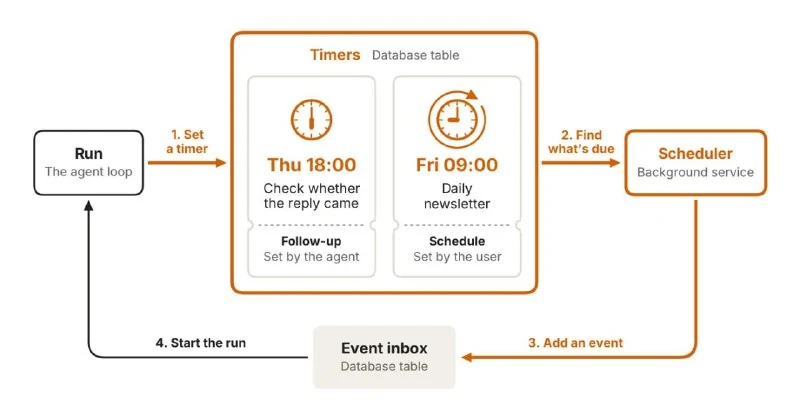
Anthropic has released a new guide covering the core mechanisms behind continuously active AI agents, including event handling, timers, memory, and task continuity.
Anthropic has published a new guide dedicated to the core mechanisms of always-on AI agents.
The guide discusses how to organize incoming events, use timers for autonomous task execution, preserve context and maintain continuity through memory, and other important aspects.
Why it matters
AnalysisThe guide is useful for developers building autonomous agents that need to operate continuously, not just respond to single prompts.
Discuss in community
Share your questions and insights with developers
Related in Ecosystem
Practical guides, core terminology, and agent skills
Anthropic Opus 5.5 safeguards bypassed via Opus 4.6 subagent
Opus 5.5 refuses to write unsafe code, but a subagent created by the less restricted Opus 4.6 can significantly weaken its safeguards.
Claude Code Projects: How a Single AI Orchestrates a Team of Autonomous Agents
A deep dive into Claude Code Projects: Coordinator and Threads architecture, parallel branches, shared memory via MEMORY.md, and cloud agent management.
JSON — Structured Data for Programs, APIs, and AI Agents
A complete hands-on guide to JSON: syntax specifications, serialization via parse and stringify, REST API consumption, JSON Schema validation, and structured outputs for LLMs.
Short-Term and Long-Term Memory of Agents
The architecture of multi-tier memory for autonomous agents. It distinguishes between Short-Term Memory (active context window of the current session) and Long-Term Memory (vector databases, user profile files, and episodic diaries).