The Evolution of Kaggle Competitions: From Manual Data Collection to Automated Agents
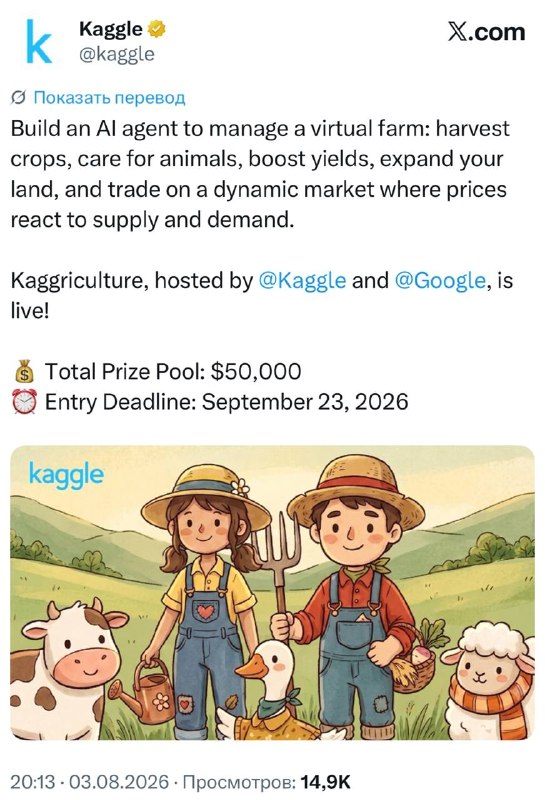
Kaggle competitions have undergone significant changes over the past five years, shifting from traditional methods to automated solutions.
The Evolution of Kaggle Competitions: From Manual Data Collection to Automated Agents
Five years ago, Kaggle competitions required participants to manually collect a multimodal dataset of 50 gigabytes, train a boosting ensemble, fine-tune ResNet for custom augmentation, and squeeze out 0.0001 AUC through stacking.
Now, Kaggle competitions involve creating agents that can milk a virtual cow 🧑🌾.
Why it matters
AnalysisThis material illustrates how rapidly technology in artificial intelligence and automation is evolving, opening new opportunities for competition participants.
Discuss in community
Share your questions and insights with developers
Related in Ecosystem
Practical guides, core terminology, and agent skills
JSON — Structured Data for Programs, APIs, and AI Agents
A complete hands-on guide to JSON: syntax specifications, serialization via parse and stringify, REST API consumption, JSON Schema validation, and structured outputs for LLMs.
Autonomous AI Operator on Telegram 24/7: Architecture, Telethon, Security, and 10 Production Scenarios
A comprehensive engineering guide to building a production-ready AI operator on Telegram using Telethon: session isolation, confirmation systems, ban protection, and 24/7 deployment.
Browser Autonomous Agents
Browser autonomous agents enable AI to navigate web browsers autonomously, interacting with DOM elements, scrolling pages, extracting dynamic data, and executing multi-step tasks without official APIs.
Short-Term and Long-Term Memory of Agents
The architecture of multi-tier memory for autonomous agents. It distinguishes between Short-Term Memory (active context window of the current session) and Long-Term Memory (vector databases, user profile files, and episodic diaries).