Terence Tao introduces Math 2.0: how AI should deepen, not replace, mathematical understanding
Mathematician Terence Tao gave a major Caltech lecture on mathematics in the AI era and shared slides, arguing that blindly optimizing solved problems can harm mathematics and that AI should strengthen human understanding.
Terence Tao gave a major lecture at Caltech on mathematics in the AI era and published the slides
He called the lecture “Math 2.0”, although in May he had planned to present it under the title “Machine Assisted Proof”. Tao himself notes that the content changed noticeably “due to recent events”.
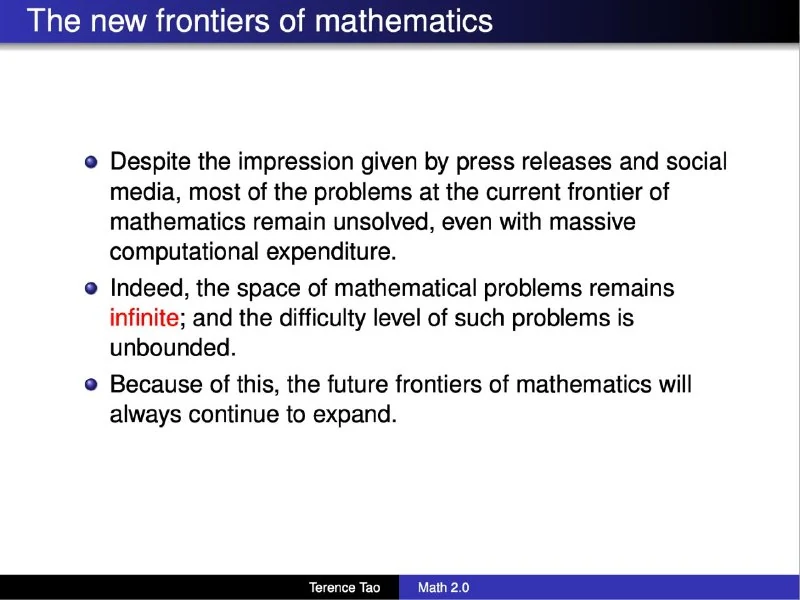
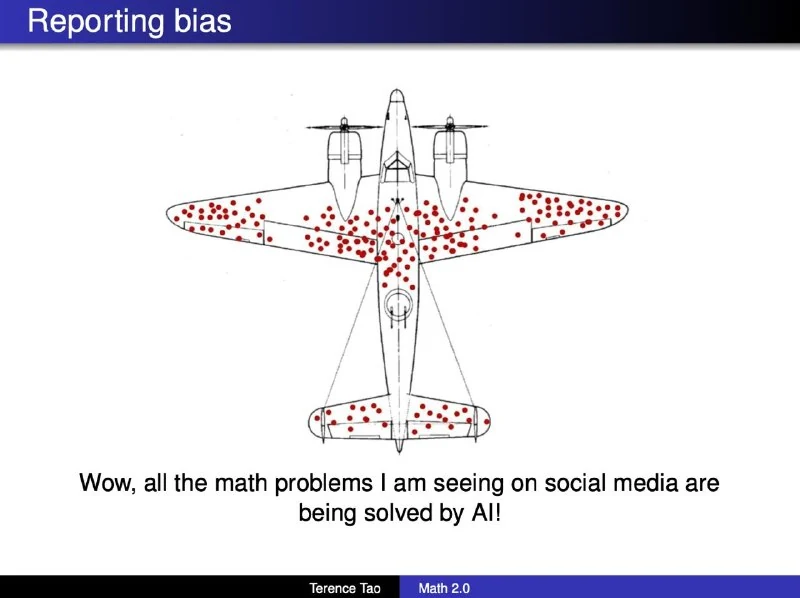
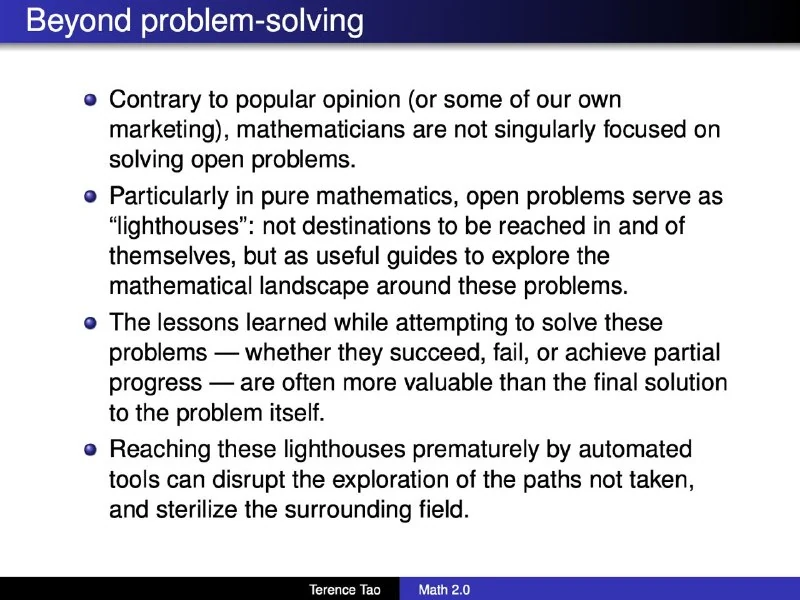
The central idea: mathematics long rested on the assumption that solving an open problem is extremely difficult and happens rarely. Around this assumption grew institutions, career incentives, and traditions. In reality, solving problems is only a proxy metric; the broader goal of science is exploration, finding new problems, and understanding how to apply solutions in the real world.
This proxy metric once worked because, by solving problems, mathematicians accumulated experience and understanding. Now, Tao says, further blind optimization of problem-solving alone is “actively harmful to the long-term health of mathematics”.
If AI simply produces solutions while bypassing humans, it sterilizes the field around the problem: untried paths remain untried, the cycle becomes non-renewable, understanding does not accumulate, and the share of solutions that “work on paper” but diverge from what the world actually needs grows.
Tao offers a thought experiment: AI invents a cocktail that kills all cancer cells, and it is even validated by Phase III clinical trials. Would you inject it without knowing that at least one human expert understands the mechanism?
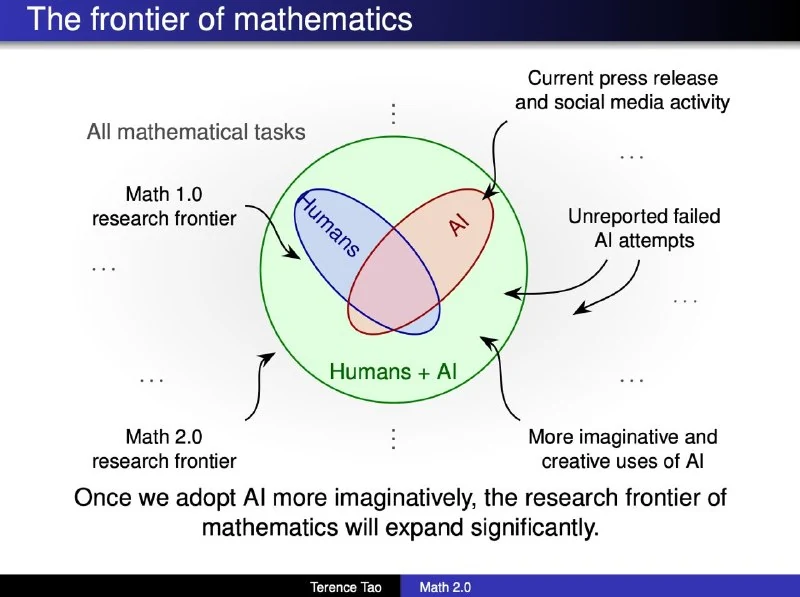
As a solution, Tao proposes shifting the focus from destroying open problems to using AI to strengthen human understanding. That is what he calls “Math 2.0”. AI can genuinely accelerate progress if it seeks explanations and new principles and explores the neighborhoods of hypotheses, rather than merely generating proofs. This is a vast untapped field, and Tao says the main limitation is no longer technology, but imagination.
Why it matters
AnalysisIt reframes AI’s role in science from automated answer generation to human-centered understanding, a crucial design principle for AI tools in research.
Discuss in community
Share your questions and insights with developers
Related in Ecosystem
Practical guides, core terminology, and agent skills
AMS President Reports Proof of Generalized Riemann Hypothesis Alongside Anthropic Announcement
Ravi Vakil, president of the American Mathematical Society, announced a proof of the Generalized Riemann Hypothesis at the same time as an Anthropic announcement, emphasizing the work was done by a human.
Hermes Profile: OSINT Researcher & Deep Web Intelligence
Hermes open-source intelligence (OSINT) profile: multi-hop web investigation, primary source verification, competitive intelligence, and citation-backed synthesis.
NotebookLM + Perplexity for work, study and income
What is NotebookLM and Perplexity
Why a proof of the Riemann hypothesis is compared to an AI breakthrough
Alexandr Wang's essay frames the Riemann hypothesis as a benchmark for AI, linking formal verification in Lean to a new era of machine-driven mathematics.