Kimi K3.1 Launches as a 2.8T-Parameter AI Model
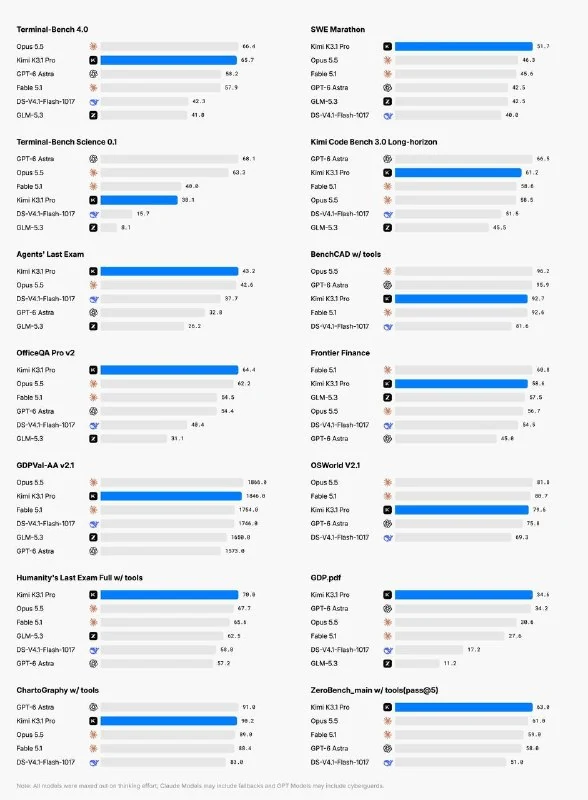
Kimi K3.1 is described as a very large open model with 2.8 trillion parameters and 104 billion active parameters, but its weights have not yet been released.
Kimi K3.1 Launches as a 2.8T-Parameter AI Model
Kimi K3.1 is a very large model with 2.8 trillion parameters, of which 104 billion are active. The model weights have not been published yet; the developers promise to release them in a couple of weeks.
According to the announcement, the model is already competitive with frontier systems such as Opus 5.5, Astra and Fable 5.1. This reinforces a broader trend: the gap between Chinese open-source AI and closed American models is narrowing with each new release.
Why it matters
AnalysisIf the weights are released, researchers and developers will gain access to a frontier-scale open model. The release also signals that Chinese open-source AI is closing the distance to top proprietary systems.
Discuss in community
Share your questions and insights with developers
Related in Ecosystem
Practical guides, core terminology, and agent skills
Kimi K3.1: teaser hints at new model from the Kimi team
The Kimi team published a teaser suggesting a fast arrival of Kimi K3.1, expected to be the best among available Chinese AI models and significantly cheaper than Kimi K3.
Kimi K3.1 Pro officially unveiled: 3T parameters and a 1M-token context window
Kimi has introduced the first model in its K3.1 family, featuring 3 trillion parameters and a 1-million-token context window, with full weights expected on November 4.
Part II. AI Agent Architecture: From Model to Memory and Tools
A deep engineering dive: tokenization, KV-cache, sampling determinism, the training stack, quantization, context engineering, the safety stack, production RAG, ReAct, and multi-agent swarm systems.
Frontier Models
The most powerful class of artificial intelligence at the forefront of global research (Claude 3.7 Sonnet, OpenAI o3/GPT-4.5, Gemini 2.0 Pro), defining the limits of modern reasoning, autonomy, and coding capabilities.
LLM (Large Language Model)
A fundamental class of neural network architectures based on autoregressive transformers, predicting the probabilistic distribution of subsequent tokens and demonstrating emergent properties of abstract reasoning, code synthesis, and logical inference.
Part I. AI Agent Architecture: The Foundations
The eleven foundational building blocks of modern autonomous agents: model taxonomy, the agentic runtime loop, advanced prompting, distillation, skills architecture, memory systems, function calling, and FinOps.