Hinton, Bengio and 20 other researchers publish paper on intelligence explosion
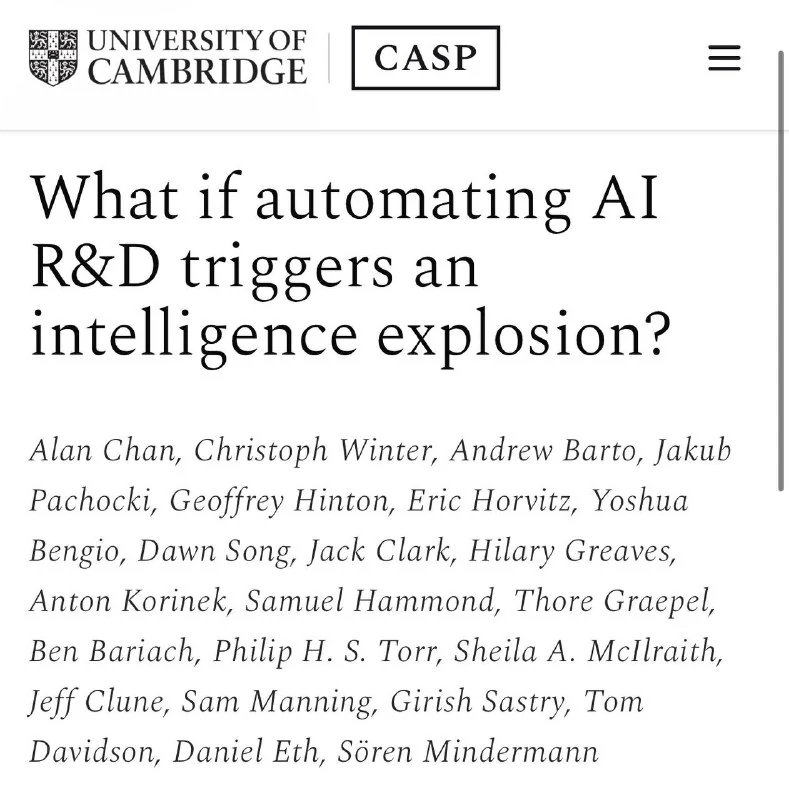
A 22-author paper argues that AI could accelerate its own development enough to compress years of progress into months, and calls for pre-emptive oversight mechanisms.
Geoffrey Hinton, Yoshua Bengio and 20 other researchers have published a paper on the “intelligence explosion.” The work came out of Cambridge and has 22 authors, including OpenAI Chief Scientist Jakub Pachocki and Anthropic co-founder Jack Clark. Its central question is what happens if AI begins to accelerate AI development so much that years of progress compress into months.
The paper starts from what is already happening inside labs. At Anthropic, the share of code written by models has grown from single-digit percentages to more than 80% since early 2025, while the share of R&D tasks performed autonomously by AI rose from 1% to 26% over six months.
The logic of the explosion is simple: models expand the research workforce, the workforce makes models better, and the cycle repeats. The compute of one lab would be enough to equal millions of top researchers. If historical rates of returns to research persist, after full automation progress could accelerate 10-fold in roughly a year and a half.
The scenario may not materialize if it hits limits in compute, data or pretraining duration, but the authors consider the risks serious. Society could fail to adapt, people could lose control over models, and the leader of the race could gain too large an advantage.
The authors advise regulators to require labs to report the degree of R&D automation and to allow external auditors to inspect models before internal deployment. They also recommend preparing slowdown mechanisms in advance: limits on capability growth over a period, the ability to pause specific workloads in data centers, and international agreements with verification of compliance.
If the explosion begins, the authors say, it may already be too late to decide anything.
Why it matters
AnalysisThis matters because it frames AI self-acceleration as a governance problem: if R&D automation compounds, existing regulatory and safety timelines may be too slow.
Discuss in community
Share your questions and insights with developers
Related in Ecosystem
Practical guides, core terminology, and agent skills
Anthropic goes public with shares trading near $100
Anthropic completed an $81 billion IPO and raised another $26 billion through a private placement to large investors, with demand exceeding supply sevenfold.
Harvard Launches AI Safety Graduate Course with OpenAI and Anthropic Speakers
Harvard is offering a graduate AI safety course this fall, featuring researchers from OpenAI and Anthropic and free lecture recordings on YouTube.
How to Build a Custom Design System in Claude Design: From Moodboard to Animated Mascot
Complete practical guide to building a brand design system in Claude Design: visual references, 4 diverging concepts, tokenization, stress-testing, and animated SVG mascot design.
Claude Code Projects: How a Single AI Orchestrates a Team of Autonomous Agents
A deep dive into Claude Code Projects: Coordinator and Threads architecture, parallel branches, shared memory via MEMORY.md, and cloud agent management.