Attackers exploit SSHole vulnerability in Alpine Linux to add their own SSH keys
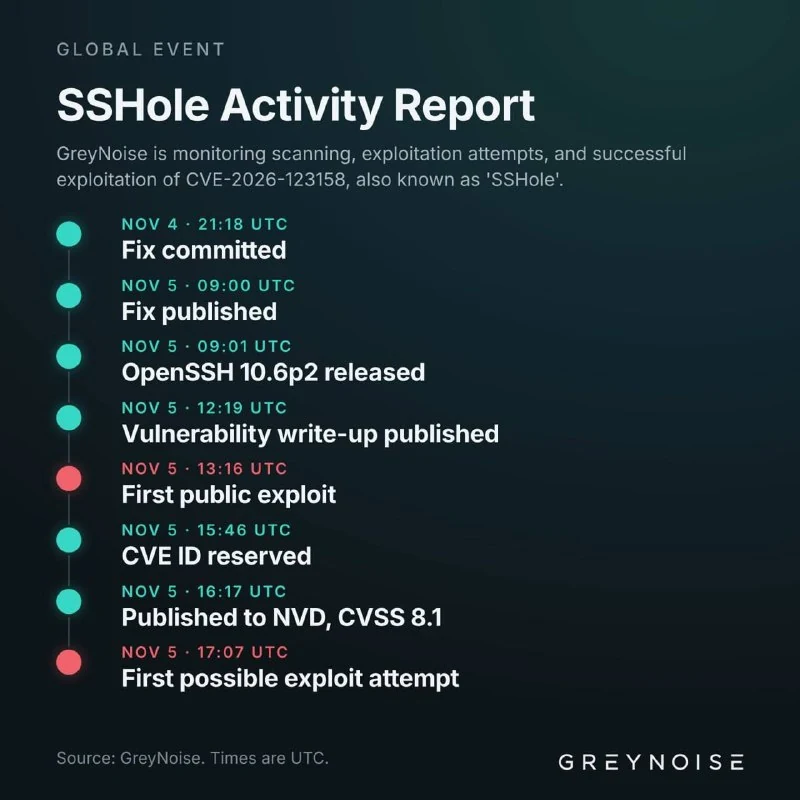
Attackers are exploiting an SSHole vulnerability in Alpine Linux to gain server access without passwords and add their own SSH keys for root and alpine users.
Attackers have gained access to Alpine Linux and started adding their own SSH keys for root and alpine users.
The SSHole vulnerability was detected several days ago, but attacks are still ongoing. It allows adversaries to access servers without entering a password.
Researchers observed the attacks on a honeypot server and identified four conditions that may put a system at risk:
- The
openssh-serverpackage is installed without PAM, oropenssh-server-pamis configured withUsePAM no. - Password login is enabled:
PasswordAuthentication yes, which is the default OpenSSH setting. - An account exists with
*in the password field. This includesrootin the base image, users authenticated only by keys, and thealpineuser in tiny-cloud images. - At least one local account uses a `$5Attackers have gained access to Alpine Linux and started adding their own SSH keys for root and alpine users.
The SSHole vulnerability was detected several days ago, but attacks are still ongoing. It allows adversaries to access servers without entering a password.
Researchers observed the attacks on a honeypot server and identified four conditions that may put a system at risk:
- The
openssh-serverpackage is installed without PAM, oropenssh-server-pamis configured withUsePAM no. - Password login is enabled:
PasswordAuthentication yes, which is the default OpenSSH setting. - An account exists with
*in the password field. This includesrootin the base image, users authenticated only by keys, and thealpineuser in tiny-cloud images. - At least one local account uses a or `$6Attackers have gained access to Alpine Linux and started adding their own SSH keys for root and alpine users.
The SSHole vulnerability was detected several days ago, but attacks are still ongoing. It allows adversaries to access servers without entering a password.
Researchers observed the attacks on a honeypot server and identified four conditions that may put a system at risk:
- The
openssh-serverpackage is installed without PAM, oropenssh-server-pamis configured withUsePAM no. - Password login is enabled:
PasswordAuthentication yes, which is the default OpenSSH setting. - An account exists with
*in the password field. This includesrootin the base image, users authenticated only by keys, and thealpineuser in tiny-cloud images. - At least one local account uses a `$5Attackers have gained access to Alpine Linux and started adding their own SSH keys for root and alpine users.
The SSHole vulnerability was detected several days ago, but attacks are still ongoing. It allows adversaries to access servers without entering a password.
Researchers observed the attacks on a honeypot server and identified four conditions that may put a system at risk:
- The
openssh-serverpackage is installed without PAM, oropenssh-server-pamis configured withUsePAM no. - Password login is enabled:
PasswordAuthentication yes, which is the default OpenSSH setting. - An account exists with
*in the password field. This includesrootin the base image, users authenticated only by keys, and thealpineuser in tiny-cloud images. - At least one local account uses a §§TOK_8§§ or `$6Attackers have gained access to Alpine Linux and started adding their own SSH keys for root and alpine users.
The SSHole vulnerability was detected several days ago, but attacks are still ongoing. It allows adversaries to access servers without entering a password.
Researchers observed the attacks on a honeypot server and identified four conditions that may put a system at risk:
- The
openssh-serverpackage is installed without PAM, oropenssh-server-pamis configured withUsePAM no. - Password login is enabled:
PasswordAuthentication yes, which is the default OpenSSH setting. - An account exists with
*in the password field. This includesrootin the base image, users authenticated only by keys, and thealpineuser in tiny-cloud images. - At least one local account uses a or password hash.
If any one of these conditions is met, the system may be vulnerable to attack.
Why it matters
AnalysisThis matters because default or common OpenSSH configurations can expose servers to passwordless compromise and persistent attacker access.
Discuss in community
Share your questions and insights with developers
Related in Ecosystem
Practical guides, core terminology, and agent skills
SSH Keys
An asymmetric pair of cryptographic keys (public and private) used by the Secure Shell (SSH) protocol for authentication without transmitting secrets over an unsecured network.
Production VPS Hardening Blueprint: From Zero to Fortress (UFW, Fail2ban, SSH)
Production-grade Linux server security: SSH key enforcement, root login disable, UFW firewall, and Fail2ban brute-force protection.
Hetzner VPS Setup
From a blank server to a secured production-ready machine. Choose how you want to set up your server.
Agent Identity & DID (Decentralized Identifiers)
Cryptographic standards (DIDs, Verifiable Credentials, mTLS) that provide autonomous AI agents with a legally and technically recognized identity, signing rights, and action auditing.