AI agent autonomously performs mouse brain surgery
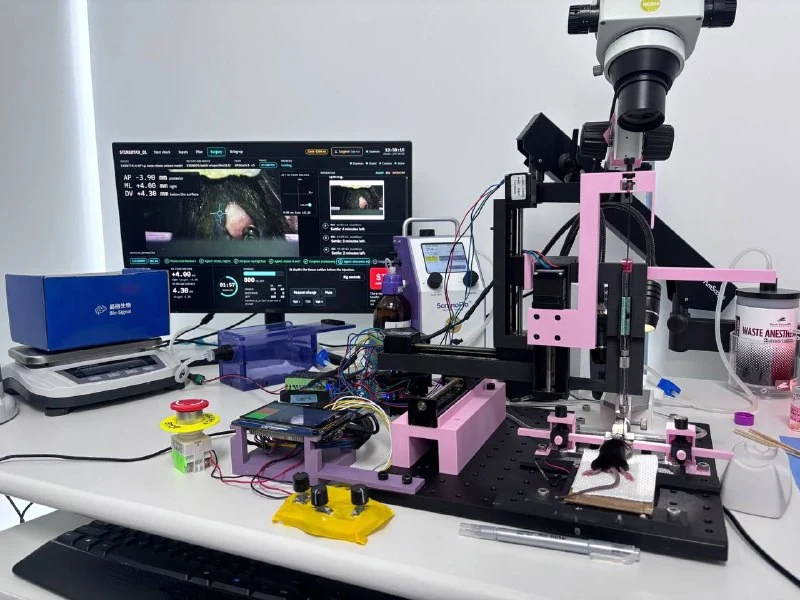
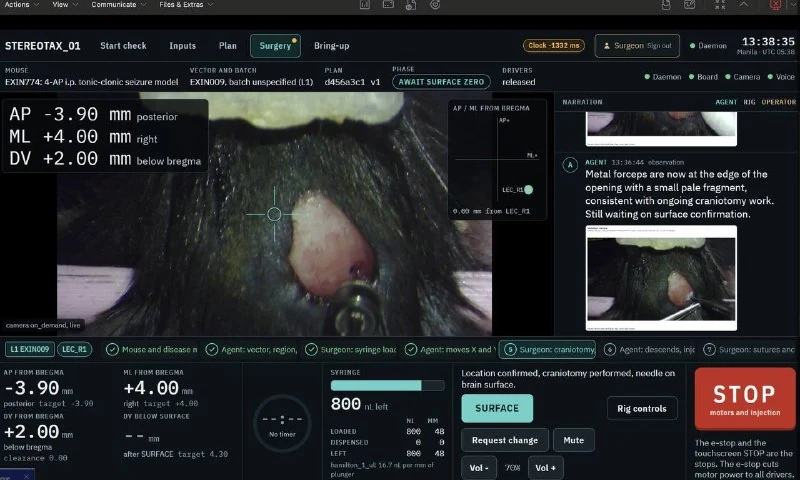
Researchers at Exin Therapeutics let the Sonnet 5 AI agent autonomously carry out stereotaxic brain surgery on an epilepsy-model mouse.
The experiment was conducted by researchers from Exin Therapeutics. The Sonnet 5 agent was given a table of gene therapy vectors, a mouse with an epilepsy model, and access to a motorized surgical rig equipped with cameras.
The goal was to reduce the number of seizures. The agent was not told exactly what to inject or where. It independently inferred the seizure mechanism in this model, selected a therapy method and brain region, and calculated coordinates from three scientific papers. Then, controlling stereotaxic manipulators and using camera feedback, it inserted a needle into the brain and injected the required drug.
A veterinarian supervised the process and confirmed each step, but the agent otherwise operated autonomously.
Notably, the surgery was originally supposed to be performed by Opus 5.5, but it immediately refused after recognizing the medical task. Opus 5 completed a full rehearsal using water and millimeter paper, but also stopped before the real procedure, explaining that it feared making a mistake mid-surgery on a live patient. Sonnet 5 ultimately carried out the operation.
According to the authors, the mouse recovered well.
Why it matters
AnalysisThe case shows that AI agents can autonomously handle complex physical tasks, while raising urgent questions about safety, oversight and autonomy in medicine.
Discuss in community
Share your questions and insights with developers
Related in Ecosystem
Practical guides, core terminology, and agent skills
AI in Business Processes: From Diagnostics to a Production-Ready Hermes Agent
A comprehensive practical B2B playbook covering process diagnostics, single-agent workflows, tooling, memory, security, evaluation, observability, and runbooks.
Claude Code Projects: How a Single AI Orchestrates a Team of Autonomous Agents
A deep dive into Claude Code Projects: Coordinator and Threads architecture, parallel branches, shared memory via MEMORY.md, and cloud agent management.
Agentic Loop: Steps of Thought ➔ Action ➔ Observation (ReAct)
A fundamental algorithmic pattern for autonomous agents, known as ReAct: Reasoning + Acting, consisting of an infinite cycle of three steps: 1) Thought — situation analysis; 2) Action — tool invocation; 3) Observation — result analysis and plan adjustment.
AI Agents (Autonomous Agents)
An autonomous system based on a large language model that not only responds to messages but independently plans a sequence of actions, utilizes external tools (browser, terminal, databases), and executes complex tasks without constant human oversight.