Yann LeCun at CoRL: LLMs already do a lot, but JEPA is still smarter
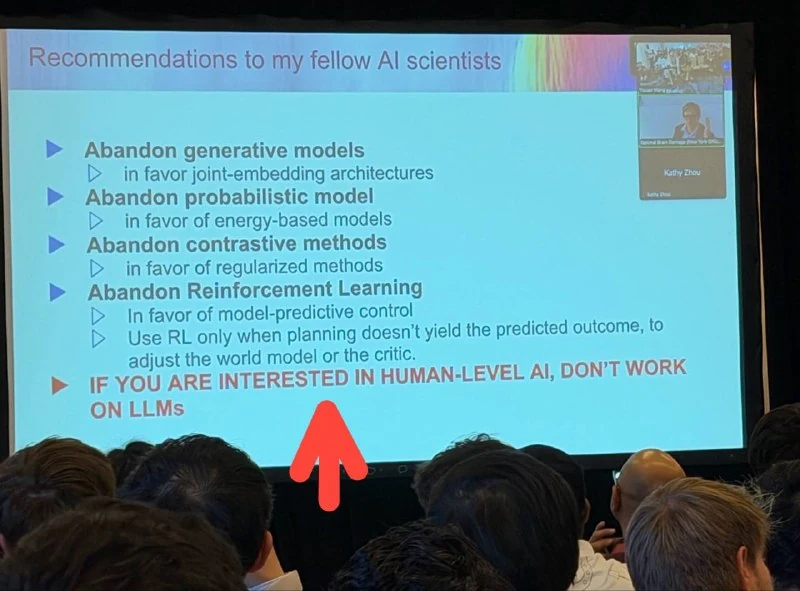
During a CoRL presentation in Austin, Yann LeCun contrasted LLMs’ practical achievements with his continued support for JEPA.
At the CoRL conference currently taking place in Austin, Yann LeCun presented a talk contrasting the practical successes of large language models (LLMs) with his view of JEPA.
In a joking tone, he listed what LLMs already do: solve long-standing mathematical problems, write a large share of code in industry, design proteins, and even find software vulnerabilities. At the same time, LeCun emphasized that, in his view, JEPA is still smarter.
“LLMs: they solve millennium-scale math problems, write 80% of code in industry, design proteins, and crack software. But JEPA is still smarter!”
The joke captures a broader debate in the AI community: LLMs are already powerful general-purpose tools, while JEPA (Joint Embedding Predictive Architecture) is presented as a different path toward learning by predicting representations rather than only predicting text tokens.
Why it matters
AnalysisIt highlights the ongoing debate about whether scaling LLMs is enough or whether new architectures like JEPA are needed for more robust AI.
Discuss in community
Share your questions and insights with developers
Related in Ecosystem
Practical guides, core terminology, and agent skills
Part I. AI Agent Architecture: The Foundations
The eleven foundational building blocks of modern autonomous agents: model taxonomy, the agentic runtime loop, advanced prompting, distillation, skills architecture, memory systems, function calling, and FinOps.
Part II. AI Agent Architecture: From Model to Memory and Tools
A deep engineering dive: tokenization, KV-cache, sampling determinism, the training stack, quantization, context engineering, the safety stack, production RAG, ReAct, and multi-agent swarm systems.
Frontier Models
The most powerful class of artificial intelligence at the forefront of global research (Claude 3.7 Sonnet, OpenAI o3/GPT-4.5, Gemini 2.0 Pro), defining the limits of modern reasoning, autonomy, and coding capabilities.
LLM (Large Language Model)
A fundamental class of neural network architectures based on autoregressive transformers, predicting the probabilistic distribution of subsequent tokens and demonstrating emergent properties of abstract reasoning, code synthesis, and logical inference.