Thinking Machines releases Inkling 2 Small: a MoE model that competes with larger flagships
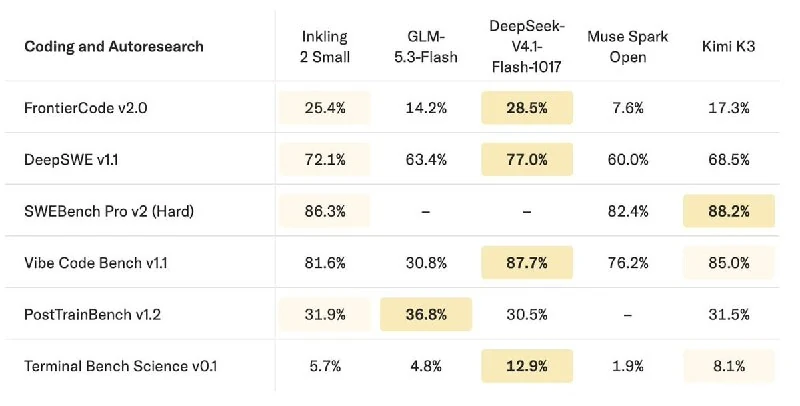
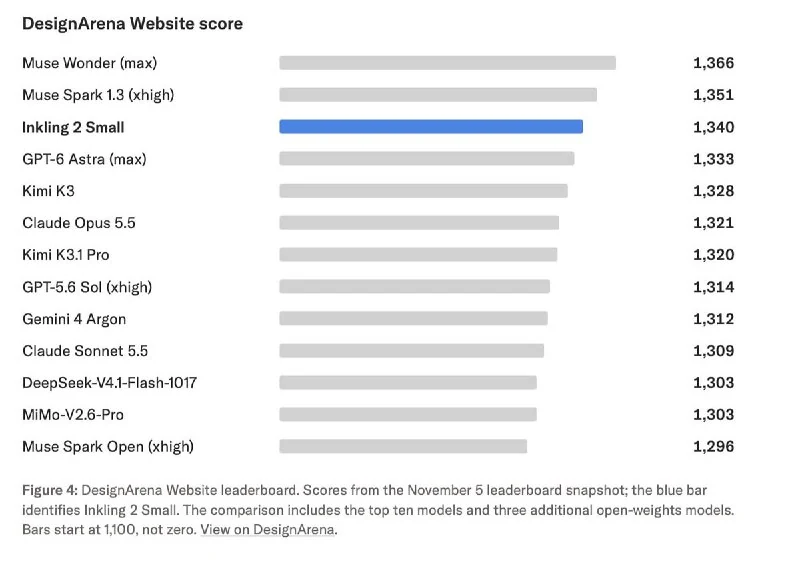
Thinking Machines introduced Inkling 2 Small, a multimodal Mixture-of-Experts model with 594B total parameters and 17B active per token. Full weights are promised next week under Apache 2.0.
Thinking Machines has released Inkling 2 Small, a model that, despite its size, is able to compete with much larger flagships.
It is built on a Mixture-of-Experts architecture and has 594 billion parameters, but only 17 billion are activated when processing each token. In addition, the model can work with images and allows users to adjust the depth of reasoning.
In programming tests, Inkling 2 Small matches many significantly larger models. The most notable result is third place in DesignArena, where it ranked just behind the most powerful closed models.
Full weights are promised to be published next week under the Apache 2.0 license.
Why it matters
AnalysisIt shows that MoE can deliver flagship-level performance with lower per-token compute. Apache 2.0 weights could enable broader experimentation and deployment.
Discuss in community
Share your questions and insights with developers
Related in Ecosystem
Practical guides, core terminology, and agent skills
Thinking Machines Releases Inkling 2 Small: a 594B MoE Model That Can Fine-Tune Other Models
Thinking Machines released Inkling 2 Small, a 594B-parameter MoE model that leads among open models in several benchmarks and demonstrated autonomous fine-tuning of Qwen3.5-4B.
Part II. AI Agent Architecture: From Model to Memory and Tools
A deep engineering dive: tokenization, KV-cache, sampling determinism, the training stack, quantization, context engineering, the safety stack, production RAG, ReAct, and multi-agent swarm systems.
Frontier Models
The most powerful class of artificial intelligence at the forefront of global research (Claude 3.7 Sonnet, OpenAI o3/GPT-4.5, Gemini 2.0 Pro), defining the limits of modern reasoning, autonomy, and coding capabilities.
LLM (Large Language Model)
A fundamental class of neural network architectures based on autoregressive transformers, predicting the probabilistic distribution of subsequent tokens and demonstrating emergent properties of abstract reasoning, code synthesis, and logical inference.