Tencent releases Hy4: an open-weight model challenging DeepSeek
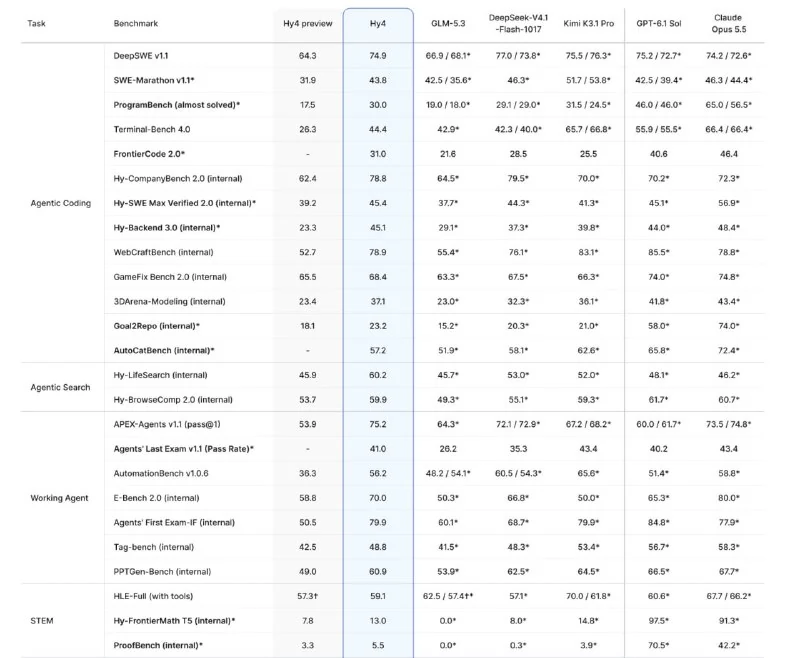
Tencent has released Hy4, a multimodal model that scored 75.2 on APEX-Agents in internal tests, ahead of DeepSeek V4.1 Flash-1017. The company plans to publish the model weights.
Tencent has released Hy4, a new model that could seriously compete with the strongest open-weight AI models.
According to Tencent's internal tests, Hy4 scored 75.2 points on the APEX-Agents benchmark, ahead of DeepSeek V4.1 Flash-1017, which received 72.1 and 72.9 points.
However, in other tests the advantage shifts from one model to the other.
The cost of using Hy4 via API is $0.834 per million input tokens and $2.501 per million output tokens.
The model also supports image input and is designed for a wide range of tasks, including programming, financial analysis, game development and scientific research.
In addition, Tencent intends to publish the weights of Hy4.
Until November 15, Hy4 can be used for free in WorkBuddy, subject to daily limits.
Why it matters
AnalysisHy4 suggests that the open-weight AI race is intensifying, with Tencent offering a multimodal alternative at a competitive API price.
Discuss in community
Share your questions and insights with developers
Related in Ecosystem
Practical guides, core terminology, and agent skills
DeepSeek (Chinese Breakthrough in Open AI)
A series of groundbreaking open models from the Chinese lab DeepSeek (V3, R1). Demonstrates top-tier coding and reasoning capabilities at a cost 10–20 times lower than Western commercial counterparts.
DeepSeek-R1 (DeepSeek Reasoning Model)
A groundbreaking open weights reasoning model based on a 671B MoE architecture, demonstrating the capability for advanced logical reasoning through pure Reinforcement Learning (GRPO).
Claude Sonnet 4.6 vs GPT-5.5 vs Gemini 3.1 Pro: 2026 model comparison
Every few weeks, a new model comes out, and every time the same questions arise: should I switch? what changed what to pay for?
Revolut shifts 2,000 engineers to locally deployed GLM models for coding
Revolut moved about 2,000 engineers to locally deployed GLM models, cutting AI coding costs by roughly tenfold and reducing task completion time by 70%.