Practical Guide with 40+ Tips for Claude Code
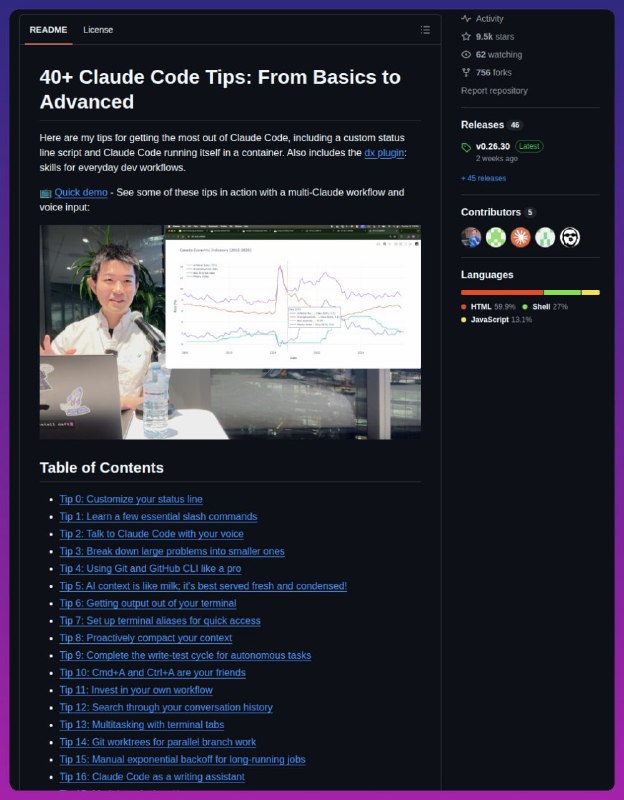
This practical guide offers over 40 tips to enhance skills in using Claude Code, including customization and AI context management.
Practical Guide with 40+ Tips for Claude Code
This guide provides over 40 tips to help you improve your skills in using Claude Code. Among the techniques discussed:
- Customizing the Status Line: Learn how to customize the status line to display important information.
- Managing AI Context: Learn to effectively manage AI context for better results.
- Using Voice Input: Explore the possibilities of voice input to simplify your work.
- Building Autonomous Workflows: Create autonomous workflows to automate routine tasks.
These tips will help you become more efficient in using Claude Code and improve your productivity.
Why it matters
AnalysisThis is important as enhancing skills in using Claude Code can significantly boost the productivity of programmers and developers, as well as simplify automation processes.
Discuss in community
Share your questions and insights with developers
Related in Ecosystem
Practical guides, core terminology, and agent skills
Claude Code Guide: Setup for Agentic Programming (Beginner-Friendly)
A comprehensive practical guide to setting up Claude Code: CLI installation, CLAUDE.md and settings.json configuration, permission matrices, automated hooks, custom /truth command, and subagents.
CSV Format: The Complete Guide for AI Workflows and Automation
A comprehensive hands-on guide to using CSV in AI data pipelines: RFC 4180 specifications, comparison with XLSX and JSON, bulk cleaning, Python/TypeScript automation, and production prompt templates.
Reddit user explains why Claude Code weekly limits are burning almost 4x faster
A Reddit user compared token usage across two weeks and found that each 1% of Claude Code's weekly limit now yields far fewer output tokens, pointing to subagents, reasoning time, and UI refresh requests as likely causes.
Event-Driven AI with Webhooks
An architectural approach to Event-Driven AI leveraging Webhooks to instantly awaken language models in response to external triggers: a new payment in Stripe, a comment on Instagram, an email, or a message in Telegram.