Moonshot AI Publishes Kimi K3.1 Pro Weights on Hugging Face
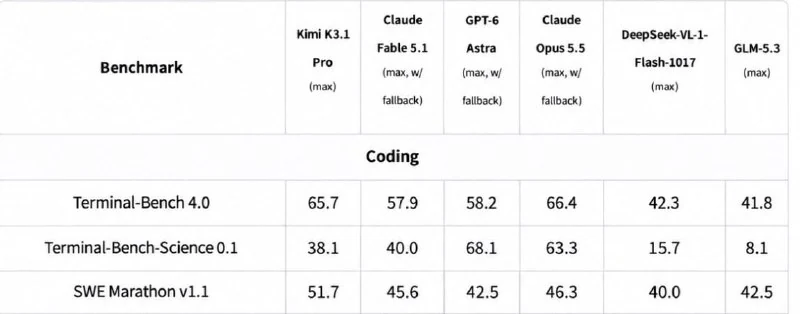
Moonshot AI released the weights of Kimi K3.1 Pro on Hugging Face, but local deployment requires extremely powerful and expensive hardware.
Moonshot AI published the weights for Kimi K3.1 Pro on Hugging Face. However, running the model locally will require substantial investment.
The model has 2.8 trillion parameters, and the weights alone reportedly take up about 1.56 TB.
For deployment, a server with eight NVIDIA B300 GPUs and 2.3 TB of total video memory can be used.
The cost of such hardware is estimated at $550,000–$650,000.
In other words, open weights are available, but the practical barrier to local inference remains extremely high.
Why it matters
AnalysisThe release highlights how frontier-scale AI models can be technically open while still being inaccessible for most local users due to memory and hardware costs.
Discuss in community
Share your questions and insights with developers
Related in Ecosystem
Practical guides, core terminology, and agent skills
We understand Hugging Face and transformers: from startup to architectures
A step-by-step guide for those who want to understand how modern language models (BERT, GPT and others) work, how to run them, use them and adapt them to their tasks - using the example of the Transformers library and the Hugging Face platform.
Hugging Face Hub
The leading global platform and open repository for the AI community ('GitHub for Neural Networks'). It hosts hundreds of thousands of open models, datasets, and free web demos (Spaces), supporting all major AI frameworks.
Kimi K3.1 Pro: Moonshot Updates Model for 3D Tooling
Moonshot released Kimi K3.1 Pro with a focus on 3D tooling, updated post-training, and an architecture change aimed at better long-context efficiency.
MIT researchers show LLMs can read and edit neural network weights without training
MIT CSAIL researchers introduced Weight-Space Programming, where an LLM directly reads and modifies model weights; Astra improved Qwen3.5-0.8B math scores without gradient descent or fine-tuning.