MIT Updates Free The Missing Semester Course with AI Agents
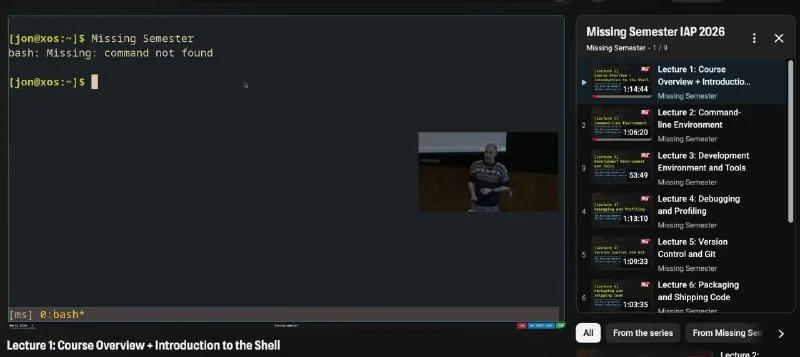
The 2026 edition adds AI agents, Claude Code, Codex, MCP, and Skills to the curriculum, alongside Shell, Git, debugging, and profiling.
MIT has updated its free The Missing Semester course to the 2026 edition. It now teaches developers to work not only with core developer tools, but also with AI agents.
The course focuses on practical skills that are often given little attention in programming education.
It starts with Shell, Git, debugging, and profiling. It then moves on to software release, code quality, and modern AI-assisted development tools: Claude Code, Codex, MCP, and Skills.
The best part: the entire course is available for free. The site includes lecture notes, hands-on exercises, and YouTube recordings.
Why it matters
AnalysisThe course closes the gap between academic programming and real engineering practice by adding skills for working with AI tools that are becoming part of the standard developer workflow.
Discuss in community
Share your questions and insights with developers
Related in Ecosystem
Practical guides, core terminology, and agent skills
Claude Code Projects: How a Single AI Orchestrates a Team of Autonomous Agents
A deep dive into Claude Code Projects: Coordinator and Threads architecture, parallel branches, shared memory via MEMORY.md, and cloud agent management.
Former Google Developer Shows How to Turn Claude Code into a Personal Assistant with MCP
A former Google developer shared how he connected Claude Code to Gmail, Calendar, Drive, Notion, Slack, Granola and HubSpot via MCP, turning it into a personal assistant with persistent context.
Hermes Profile: Educational Methodologist & Course Architecture
Hermes instructional design profile: curriculum engineering via Bloom's taxonomy, interactive microlearning, hands-on workshops, and course completion rate optimization.
AI Agents (Autonomous Agents)
Software systems based on LLMs that can autonomously perceive the state of the environment, decompose complex goals, invoke external tools, and iteratively correct their own mistakes.