Meta Releases Muse Spark 1.1
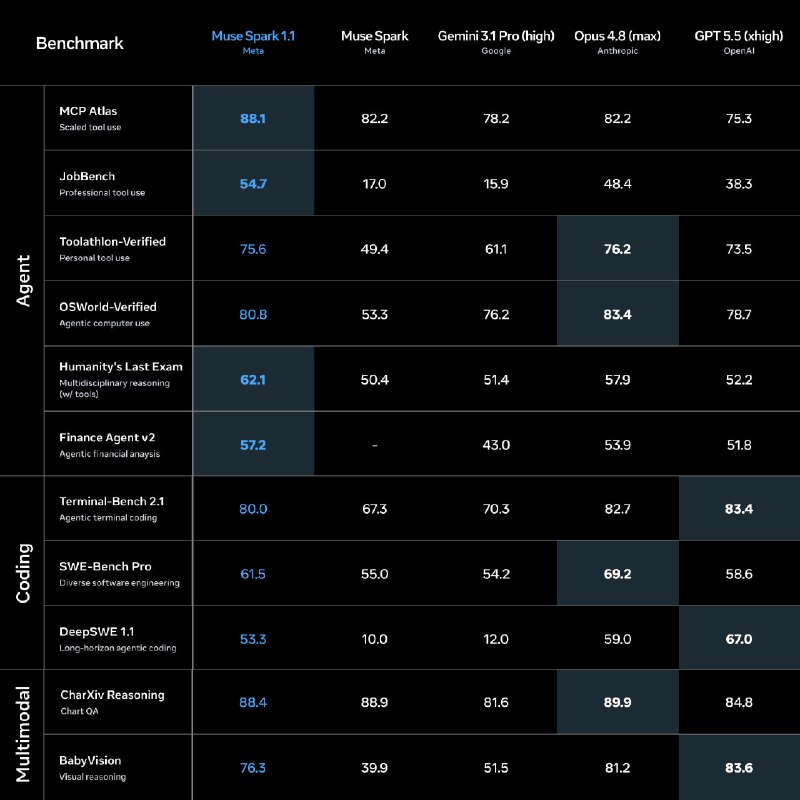
Meta has launched Muse Spark 1.1, enhancing agent coding and introducing an API with attractive conditions for new users.
Meta Releases Muse Spark 1.1
The new version of Muse Spark 1.1 from Meta offers significant improvements, particularly in agent coding. Along with the new model, the company has also launched its API, allowing users to integrate Muse Spark's capabilities into their projects.
Pricing and Credits
The cost for using Muse Spark 1.1 is $1.25/$4.25 per million tokens. For new users, Meta offers free credits of $20 to use the API, making it accessible for experimentation and development.
Why It Matters
The launch of Muse Spark 1.1 and the API opens new opportunities for developers looking to integrate AI into their solutions. It also highlights the growing competition in the AI model market, where companies strive to offer better conditions for users.
Why it matters
AnalysisThe launch of Muse Spark 1.1 by Meta showcases advancements in agent coding, which can significantly ease AI integration into various projects. It also provides new opportunities for developers through free credits for new users.
Discuss in community
Share your questions and insights with developers
Related in Ecosystem
Practical guides, core terminology, and agent skills
Llama Family (Meta Llama)
A series of foundational open language models from Meta (Llama 3, 3.1, 3.3) that have become the industrial standard for the Open Weights ecosystem, local AI, and enterprise fine-tuning.
Complete Guide to Higgsfield Cinema Studio 4.0: Scene Management, Soul 2.0, and API Automation
In-depth practical breakdown of the major Higgsfield update: Cinema Studio 4.0, consistent characters with Soul 2.0, API-based generation, and a ready-to-use UGC pipeline.
JSON — Structured Data for Programs, APIs, and AI Agents
A complete hands-on guide to JSON: syntax specifications, serialization via parse and stringify, REST API consumption, JSON Schema validation, and structured outputs for LLMs.
Function Calling / Tool Calling
A technical protocol and standard for LLM interaction with external software. Instead of free text, the model returns valid JSON containing the function name and typed arguments according to JSON Schema, enabling the backend to deterministically execute actions in real APIs.