Greg Brockman: Astra Marks the Dawn of the AGI Era
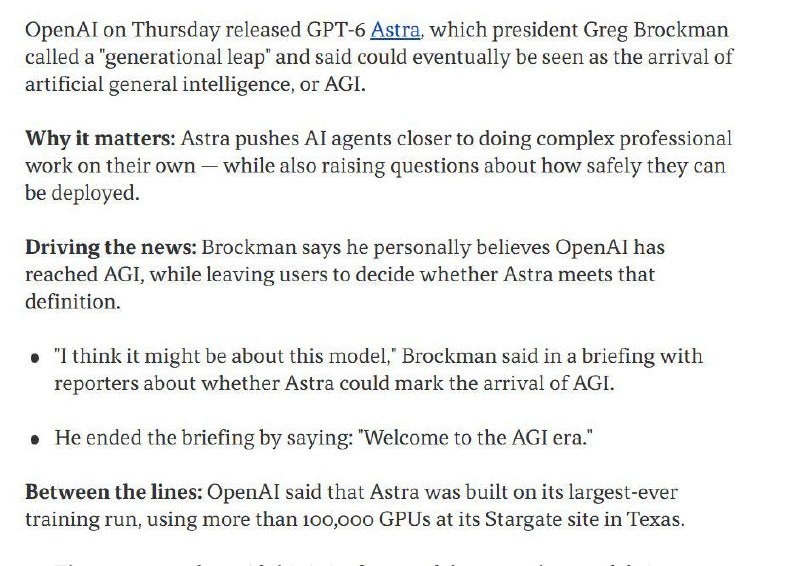
Greg Brockman, a leader at OpenAI, announced that Astra symbolizes the dawn of a new era in artificial intelligence. However, access to Astra will be limited to certain organizations for some time.
Greg Brockman, one of the leaders at OpenAI, stated that Astra symbolizes the dawn of a new era in artificial intelligence (AGI). This is an important step in the development of technologies that could change our understanding of AI and its capabilities.
It is also reported that Astra will be available for a limited number of organizations for some time, which may affect the speed of its implementation and use across various sectors.
Why it matters
AnalysisThis is significant as Astra could become a key element in the development of AGI, opening new opportunities for technology and business.
Discuss in community
Share your questions and insights with developers
Related in Ecosystem
Practical guides, core terminology, and agent skills
GPT-6 Astra: Guide to OpenAI's New Model
Comprehensive overview of OpenAI's flagship GPT-6 Astra: agentic architecture, Computer Use capabilities, software engineering in Codex, cybersecurity benchmarks, prompt engineering tips, and API migration guide.
Codex Skills for Beginners: Automating AI Agent Workflows
A comprehensive hands-on guide to building and executing Codex Skills: SKILL.md anatomy, explicit vs. auto-triggering, skills vs. scripts vs. tools, Skills API, and safety boundaries.
Artificial Superintelligence (ASI)
A hypothetical stage of artificial intelligence development (ASI) where the computational and analytical capabilities of a system surpass the combined intelligence of all living humans by millions of times across all scientific, creative, and practical disciplines. A focal point of scientific discussions about the future of civilization.
The Turing Test and Its Obsolescence
The historical artificial intelligence test proposed by Alan Turing in 1950 assesses a machine's ability to engage in text dialogue convincingly enough that a human cannot distinguish it from another human. This entry explains why the advent of language models has rendered this test scientifically irrelevant.