GPT-6 Astra Decodes WWII German Radio Message in 10 Hours
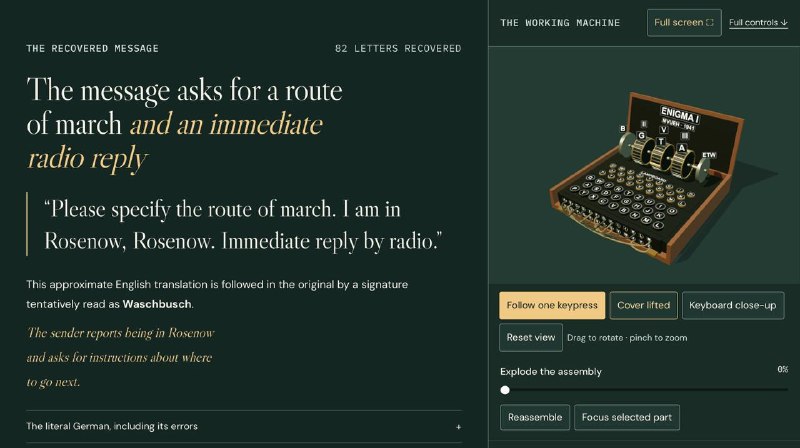
A Bloomberg developer used GPT-6 Astra Extra High to decipher a historical German radio message from 1941 that had remained unsolved for decades.
GPT-6 Astra Decodes WWII German Radio Message in 10 Hours
On July 10, 1941, a German soldier used the Enigma machine to encrypt a short message (82 characters). He reported his location in the town of Rosenow and requested instructions for further movement and an immediate radio response. When attempts were made to decrypt it, known cipher keys for that day did not match, and the message was sent to the archive of undecrypted intercepts.
Yesterday, Bloomberg developer Carter Leffen announced that he deciphered this message using GPT-6 Astra Extra High. The model searched historical archives and found an already decrypted message from the same day where the city name "Rosenow" appeared twice. Assuming this term might also appear in the undecrypted text, the model wrote code for cryptanalysis and arrived at the final decoded sequence.
Leffen set the tasks and made decisions throughout the process. Astra also designed the project website, which includes all the code, the history of the decryption, and even a 3D Enigma simulator.
Why it matters
AnalysisThis case highlights the potential of large language models to solve complex historical cryptographic puzzles by combining data analysis, code generation, and logical inference.
Discuss in community
Share your questions and insights with developers
Related in Ecosystem
Practical guides, core terminology, and agent skills
GPT-6 Astra reportedly edits another AI model's weights without retraining
GPT-6 Astra is claimed to modify only 0.016% of Qwen3.5-0.8B's weights without gradients or retraining, improving reasoning, math results, and instruction following.
GPT Image Generative Models Prompting Guide
OpenAI's gpt-image generative models are designed to produce production-quality visuals and fully controllable creative workflows. They are suitable for both professional design ta...
Claude Sonnet 4.6 vs GPT-5.5 vs Gemini 3.1 Pro: 2026 model comparison
Every few weeks, a new model comes out, and every time the same questions arise: should I switch? what changed what to pay for?
The Turing Test and Its Obsolescence
The historical artificial intelligence test proposed by Alan Turing in 1950 assesses a machine's ability to engage in text dialogue convincingly enough that a human cannot distinguish it from another human. This entry explains why the advent of language models has rendered this test scientifically irrelevant.