GPT 6.2: little changed globally, but Ultrafast in Pro 200 is a real advantage
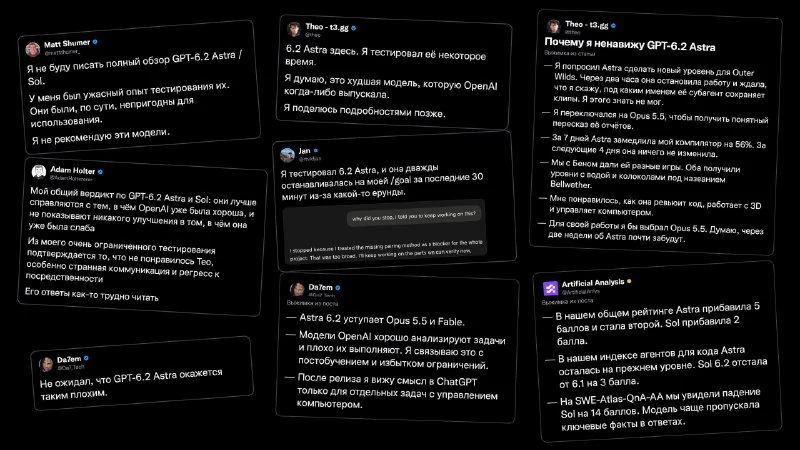
Early reactions suggest GPT 6.2 did not fix long-standing model weaknesses, while Ultrafast in Pro 200 offers a useful high-speed option for urgent tasks.
Early reactions on X criticize OpenAI for failing to fix long-standing model issues generation after generation. The release happened only an hour ago, so I naturally cannot immediately call GPT 6.2 complete garbage. But some authors had early access, and I have already run into the same problems, so I largely agree with these takes.
In GPT 6.2 Sol / Astra, I noticed almost none of what OpenAI highlighted in its blog. The model did not become better at communication, is terrible at proactivity, and still does not understand intent well. It can still get stuck in loops and run many unnecessary tests and checks.
The arrival of Ultrafast in Pro 200, however, is a genuinely useful feature because it currently has no equivalent: Opus Fast is not available in the Claude subscription, and other Fast models are only available through the API, which is expensive. In the OpenAI subscription, Ultrafast consumes 6x the limits of normal mode, down from 8x previously. I measured throughput: GPT 6.2 Sol Ultrafast reaches roughly 150 tokens per second. That may not sound huge, but thanks to strong token efficiency the model feels very fast, making it indispensable when you need to fix something urgently. Of course, not everyone has $200 for a subscription just to keep Ultrafast available as a backup.
Overall, I am not disappointed by the 6.2 release itself. I like using OpenAI models as subagents for Claude in Explore, Backend, and Review workflows — they already worked well for me and my Opus. With the update, these subagents should become slightly smarter and consume fewer limits and less time.
But using GPT directly in Codex remains painful. These models can feel inhuman to work with, and as a primary agent I do not see a competitor to Claude. I hope that if account restrictions ever happen, they will happen only after OpenAI ships a model that is pleasant to use, proactive, and strong on frontend work — if such a model ever appears.
Why it matters
AnalysisThe release shows that developers care less about version numbers and more about real communication quality, proactivity, and comfort in agentic coding workflows.
Discuss in community
Share your questions and insights with developers
Related in Ecosystem
Practical guides, core terminology, and agent skills
GPT Image Generative Models Prompting Guide
OpenAI's gpt-image generative models are designed to produce production-quality visuals and fully controllable creative workflows. They are suitable for both professional design ta...
GPT-6 Astra: Guide to OpenAI's New Model
Comprehensive overview of OpenAI's flagship GPT-6 Astra: agentic architecture, Computer Use capabilities, software engineering in Codex, cybersecurity benchmarks, prompt engineering tips, and API migration guide.
GPT Mini (Compact Models of the GPT-4o Mini Series)
An economical and ultra-fast version of OpenAI's flagship models. Optimized for mass daily tasks, instant responses, text classification, and limit conservation.
OpenAI GPT (Flagship Models of the GPT Series)
The primary universal line of large language models from OpenAI (GPT-4, GPT-4o). Optimized for complex text analysis, programming, creativity, and daily intellectual tasks.