Google DeepMind Introduces AlphaProof Code, an AI System for Formal Code Verification
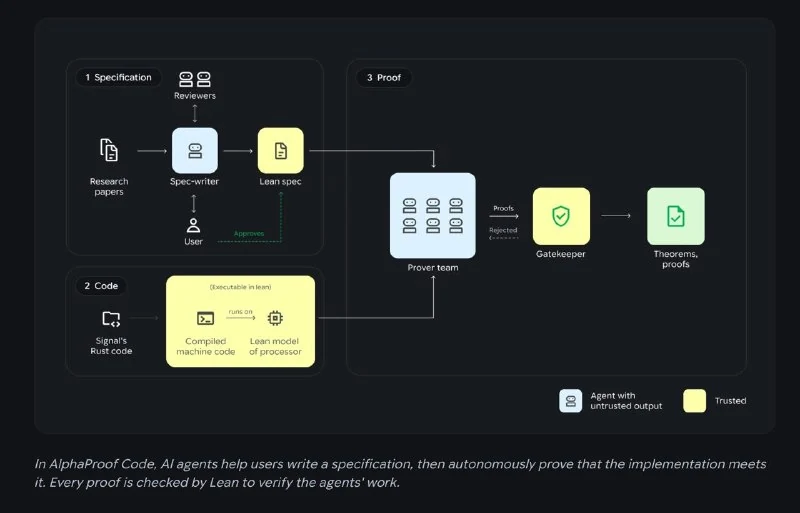
A multi-agent AI system automates formal verification, a mathematically rigorous way to prove that code satisfies security properties.
Usually code is tested empirically: with tests, reviews, and audits that look for individual bugs. Formal verification is stricter: program properties are written mathematically, and a rigorous proof is built that the code satisfies them for any input.
This is considered the highest level of security guarantees, but formal verification is rarely used because it is very expensive and very slow, and only rare specialists can do it.
AlphaProof Code is a multi-agent system that automates this kind of checking. Google says it is the first case where AI is used for formal verification of a program.
Thanks to AlphaProof Code, researchers mathematically proved that the code of the Signal cryptographic protocol (which powers messaging encryption in Signal and Google Messages) provides the claimed security guarantees.
To do this, Gemini 4 Carbon-based agents wrote more than six million lines in Lean, then audited the proof themselves and marked the places where human review was needed. About 1% of the proof required such attention. The work took four weeks; for expert teams, a task of this scale usually takes years.
The authors see formal proof as a foundation for protecting other critical systems and say it may be one of the few ways to withstand the speed and scale of modern cyberattacks.
Why it matters
AnalysisFormal verification offers the strongest software security guarantees, and AI agents could make it practical for large, complex systems.
Discuss in community
Share your questions and insights with developers
Related in Ecosystem
Practical guides, core terminology, and agent skills
Claude Code Projects: How a Single AI Orchestrates a Team of Autonomous Agents
A deep dive into Claude Code Projects: Coordinator and Threads architecture, parallel branches, shared memory via MEMORY.md, and cloud agent management.
Part II. How to Work with Codex + Optimization/Security/Team
Codex is not just code autocomplete in a chat; it is a full-fledged engineering agent: it reads the repository, plans changes, edits files, runs tests, reviews its own diffs, and c...
Hallucinated Dependencies in Code
A dangerous variant of neural network hallucinations in programming. The model fabricates plausible yet non-existent libraries and npm/PyPI packages, creating critical security vulnerabilities (Slopsquatting).
Gemini 4 Carbon and Google Antigravity: agents built a 3D exhibit from one prompt
Google Antigravity’s new /swarm feature let a team of Gemini 4 Carbon agents turn historical photos and engineering drawings into an interactive Three.js exhibit about the construction of the Eiffel Tower.