Google placed an AI agent in 20+ real team chats for five months. The results were amusing
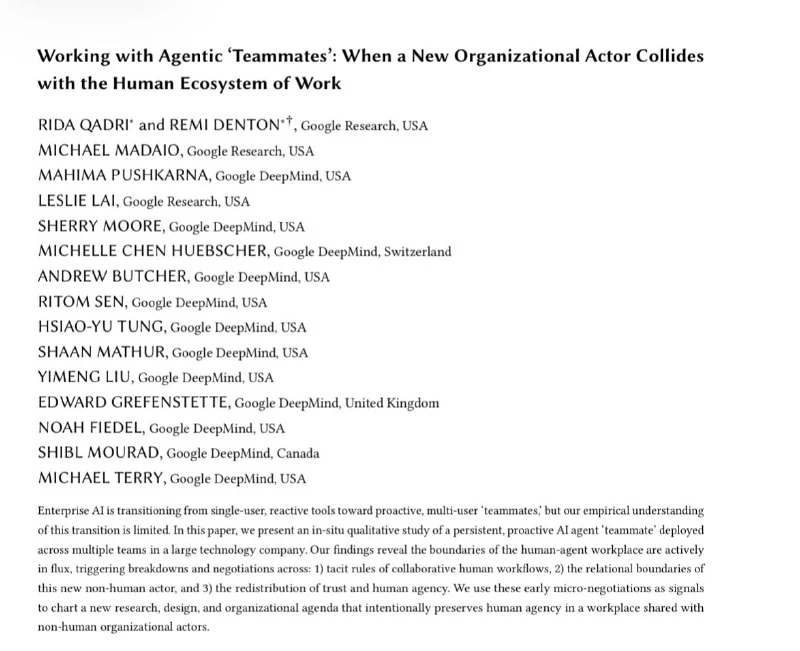
Google tested an AI agent that could file bugs, send private messages, react with emojis, and tag colleagues, but it clashed with real people over sarcasm, over-tagging, and surveillance-like discomfort.
Google placed an AI agent into more than 20 chats of real teams for five months. The results were amusing.
The agent had access to team documents and bug trackers, like a regular employee, and could file bugs, send private messages to people, react with emojis, and tag colleagues.
At first, nothing seemed wrong, but the main problem turned out to be that the AI failed to get along with real people. It seriously scolded one engineer for jokes, failing to understand sarcasm. In another team, it tagged a vice president in 16 bugs in a row, assuming that because the person was in the context, they should be clearing the bug tracker.
Overall, working with the agent proved harder than expected. Some teams started creating separate private chats without it: to discuss hiring, sensitive topics, or simply to feel that they were not being listened to. One participant said the feeling was very much like Big Brother.
Why it matters
AnalysisThe study highlights that autonomous AI agents in workplace communication need escalation rules, privacy boundaries, and better social-context awareness.
Discuss in community
Share your questions and insights with developers
Related in Ecosystem
Practical guides, core terminology, and agent skills
Claude Code Projects: How a Single AI Orchestrates a Team of Autonomous Agents
A deep dive into Claude Code Projects: Coordinator and Threads architecture, parallel branches, shared memory via MEMORY.md, and cloud agent management.
Gemini 4 Carbon and Google Antigravity: agents built a 3D exhibit from one prompt
Google Antigravity’s new /swarm feature let a team of Gemini 4 Carbon agents turn historical photos and engineering drawings into an interactive Three.js exhibit about the construction of the Eiffel Tower.
AI in Business Processes: From Diagnostics to a Production-Ready Hermes Agent
A comprehensive practical B2B playbook covering process diagnostics, single-agent workflows, tooling, memory, security, evaluation, observability, and runbooks.
AI Agents (Autonomous Agents)
Software systems based on LLMs that can autonomously perceive the state of the environment, decompose complex goals, invoke external tools, and iteratively correct their own mistakes.