Flathub Said "No" to AI Apps: Why This Was the Right Decision
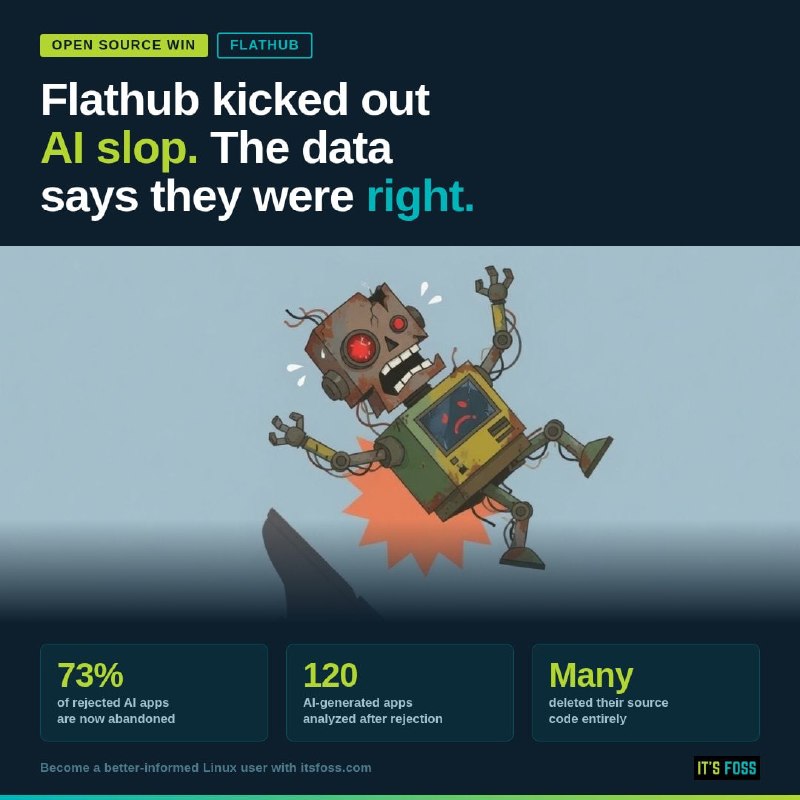
Flathub's decision to reject AI-generated applications has been validated by new data. Most of the rejected programs turned out to be abandoned projects.
Flathub Said "No" to AI Apps: Why This Was the Right Decision
When Flathub announced it would reject applications created using AI, the reaction was quite predictable. Many expressed concerns about "gatekeeping," that it was against open source principles, and raised questions like, "Who decides what counts as junk?" and "Isn't this ludditism?"
But was it the right decision to reject Linux applications created using AI? Well, now we have an answer, and it is quite clear.
One developer went back to 120 applications that Flathub rejected under its new AI policy and analyzed their fate.
73% of these repositories are now completely abandoned. Many have had their source code deleted, and some accounts have ceased to exist altogether.
Clearly, these were not pet projects that were unjustly rejected. They were one-off applications that no one intended to support for long. This type of software is referred to as abandonware.
Flathub did not back down from its position, and as a result, the ecosystem of Linux applications has become cleaner.
Why it matters
AnalysisThis decision by Flathub highlights the importance of maintaining quality software in open ecosystems. Rejecting unreliable applications can improve the overall state of software for Linux.
Discuss in community
Share your questions and insights with developers
Related in Ecosystem
Practical guides, core terminology, and agent skills
Hermes Profile: DevOps Engineer & Cloud Infrastructure
Hermes systems and DevOps engineering profile: Linux server hardening, Docker containerization, CI/CD automation pipelines, observability, and security.
How to Run DeepSeek-R1 Locally for Free on Mac, Windows, and Linux
Tired of the limitations of cloud services and constant payments for DeepSeek-R1 API? You are not alone. Many developers, AI users, and researchers want complete control over their data and workflows.
cgroups v2 Resource Quotas & OOM Watchdogs
Linux kernel mechanisms (Control Groups v2) for enforcing strict hardware limits on RAM, CPU, disk, and process counts (PIDs) to protect the host from runaway agent cycles.
eBPF Security & Runtime Auditing
A technology for safely executing bytecode directly within the Linux kernel (eBPF / Tetragon / Falco) to intercept dangerous system calls (syscalls), network connections, and file modifications by AI agents.