Computer Use is no longer enough: agents can now control a real iPhone
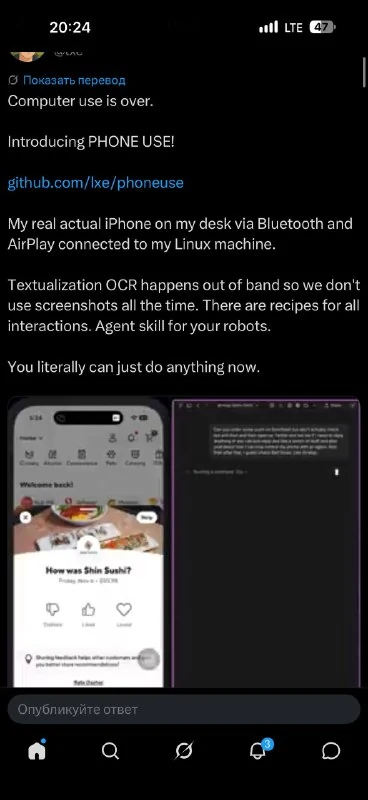
Open-source tool Phone Use lets AI agents control a physical iPhone from a computer via Bluetooth and AirPlay without jailbreaking or extra apps.
Computer Use is no longer enough: agents can now control a real iPhone
Developer Alexey Smolenchuk introduced Phone Use, an open-source tool that lets AI agents control a physical iPhone directly from a computer.
The phone connects to Linux over Bluetooth and AirPlay, while the agent can open apps, press buttons, enter text, and perform actions on behalf of the user.
All of this works without jailbreaking, a cable, or installing additional apps on the iPhone.
OCR is used for text recognition, so the agent does not need to constantly analyze screenshots.
The project is still experimental, but it looks like another step toward full AI assistants that can be tasked not only with computer workflows, but also smartphone actions.
Why it matters
AnalysisPhone Use expands agent capabilities from desktop automation to mobile devices, showing that AI assistants can operate real-world apps without deep system modifications.
Discuss in community
Share your questions and insights with developers
Related in Ecosystem
Practical guides, core terminology, and agent skills
GitHub Publishes Massive Reverse-Engineering Tool Collection for Sites, Apps, and Games
Awesome-REA gathers 1,253 sources, 431 practical cases, 235 scientific papers, and 3,309 repositories for analyzing websites, applications, and games.
OpenCode adds Browse: AI agents can control your real browser
OpenCode introduced Browse, letting an AI agent operate the user's existing browser, and temporarily made the Inkling 2 Small model free to access.
Claude Code Projects: How a Single AI Orchestrates a Team of Autonomous Agents
A deep dive into Claude Code Projects: Coordinator and Threads architecture, parallel branches, shared memory via MEMORY.md, and cloud agent management.
AI Agents (Autonomous Agents)
Software systems based on LLMs that can autonomously perceive the state of the environment, decompose complex goals, invoke external tools, and iteratively correct their own mistakes.