Claude Fable 5.2 designed several electronic devices from scratch
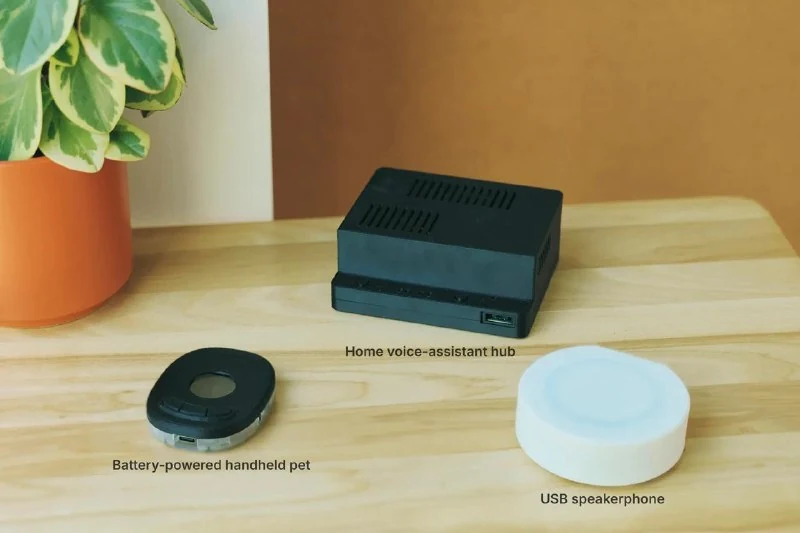
Claude Fable 5.2 turned short prompts into specifications, schematics, enclosures, firmware, and bills of materials for three prototypes assembled by Diode Computers.
Claude Fable 5.2 designed several electronic devices from scratch
In joint experiments with Diode Computers, the model designed a USB-C and Bluetooth speakerphone, a voice hub for a smart home, and a portable virtual pet.
For each device, it was given only a short prompt describing the idea and the main hardware requirements. Claude then wrote the specification, drew the schematics, placed components on the PCB, designed the enclosure, wrote the firmware, and compiled the bill of materials.
Diode engineers handled assembly and bring-up following its instructions. All three prototypes worked without schematic changes and remain stable.
The model's geometric reasoning is notable. In one example, the speakerphone PCB could not be dropped straight into the enclosure because the mute switch hit the back wall. Claude proposed mounting it at an angle of about 25° and added that step to the assembly instructions. It is a small detail, but it also demonstrates engineering attentiveness.
Why it matters
AnalysisThe result shows that AI models can move beyond code generation into full hardware design workflows, while humans still handle physical assembly and validation.
Discuss in community
Share your questions and insights with developers
Related in Ecosystem
Practical guides, core terminology, and agent skills
Anthropic releases Claude Fable-5.2: pricing, limits and AI R&D restrictions
Anthropic introduced Claude Fable-5.2, officially cheaper than the previous version but more expensive than Opus 5.5. User reports point to separate limits and training caps for AI R&D tasks.
Anthropic Releases Claude Fable 5.2
Anthropic has released Claude Fable 5.2, a new AI model that tops Artificial Analysis and Vals AI rankings while offering faster generation and lower API pricing.
Computer Use via AI
Anthropic's technology (introduced in Claude 3.5 Sonnet) enables neural networks to control operating systems like a human: taking screenshots, analyzing window coordinates, moving the mouse cursor, clicking buttons, and entering text without using specialized APIs.
Constitutional AI (RLAIF)
A behavior alignment method developed by Anthropic (creators of Claude). Instead of relying on millions of hours of human labor, the model critiques and corrects its own responses based on a clear set of ethical principles ('Constitution').