Researcher Claims Codex and Claude Helped Find a New Exoplanet in NASA Archive Data
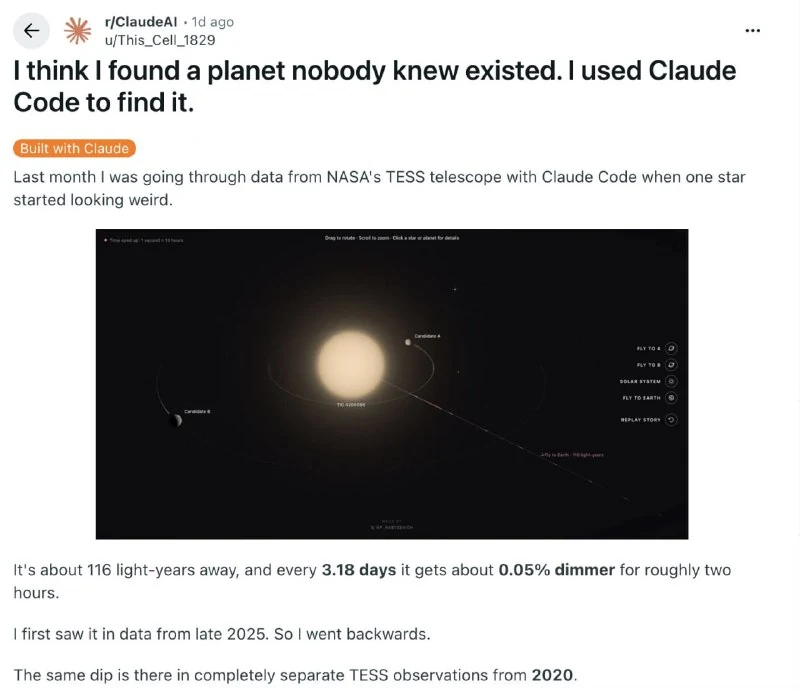
A researcher says Codex and Claude helped analyze archived NASA telescope data and identify possible exoplanet transits; NASA has approved a follow-up observation proposal.
Claude, please find aliens. Do not make a single mistake.
A researcher claims to have found a new planet by analyzing NASA telescope archive data that had been sitting unexamined for seven years with Codex and Claude.
Claude Code, powered by Opus 5.5 and Fable 5.1, did most of the work: it parsed light curves, wrote code to search for transits, fitted their parameters, and checked neighboring stars and secondary eclipses. The researcher asked questions and defined the criteria for passing or failing each check.
The star is about 116 light-years away. Every 3.18 days, its brightness drops by roughly 0.05% for about two hours. This is consistent with a planet about 1.4 times Earth's size.
NASA has already agreed to check the claimed discovery and determine whether it is a new planet. The observation proposal was approved as number 100, with verification scheduled from October 31 to November 26.
Data and code: Zenodo DOI
3D system viewer: tic4206066.pages.dev
Why it matters
AnalysisShows how coding LLMs can accelerate scientific workflows, from data parsing to hypothesis testing, while the discovery still requires independent observational validation.
Discuss in community
Share your questions and insights with developers
Related in Ecosystem
Practical guides, core terminology, and agent skills
Codex Inside Claude Code: Delegating Routine via Claudex
The real limitation in working with Claude is not how well the model can reason, but how many tasks are in the context window before it fills up.
Migrating from Claude Code to Codex: How to Move CLAUDE.md, MCP, Skills, Slash Commands, and Settings
Complete engineering guide on migrating from Claude Code to OpenAI Codex CLI: porting CLAUDE.md to AGENTS.md, configuring MCP, sandboxing, hooks, and retaining Claude models.
Several OpenAI employees depart after Anthropic IPO reports
Multiple OpenAI employees, including AI safety, robotics and Codex specialists, reportedly departed after Anthropic's public listing. The reasons remain unclear.
Developer Passed Production Database Password to Claude Code: Why It Is Risky Even With Enterprise Subscription
A junior developer copied a full production database connection string, including the admin password, into Claude Code while fixing a schema migration error. The AI assistant solved the issue quickly, but the team had to rotate the secret and restart services.