Azure Reveals Upcoming GPT-6 Sol, Luna, and Astra Models
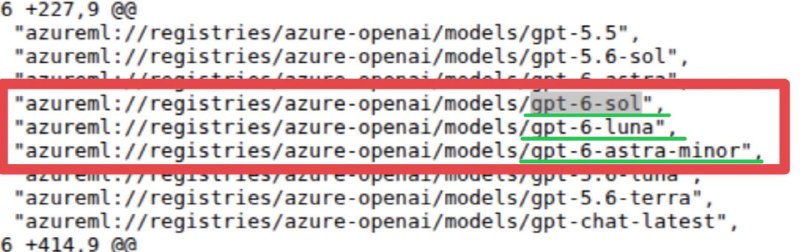
New model identifiers for GPT-6 Sol, Luna, and Astra have appeared in Azure configurations, signaling an imminent release.
Azure Reveals Upcoming GPT-6 Sol, Luna, and Astra Models
New AI model identifiers—gpt-6-sol, gpt-6-luna, and gpt-6-astra-minor—have surfaced in Azure's configuration files. This discovery suggests that these models are in the final stages of preparation for release.
Additionally, the same commit indicates that the GPT-5.6 Sol model has been designated as a workhorse, highlighting its current role in production environments before the next generation arrives.
These new models have already been added to Microsoft's model registry. While there has been no official announcement from OpenAI or Microsoft yet, the technical infrastructure within Azure is clearly gearing up for the launch of the GPT-6 series.
Why it matters
AnalysisThese technical leaks provide the first concrete evidence that OpenAI and Microsoft are finalizing preparations for the GPT-6 era, potentially reshaping the generative AI landscape.
Discuss in community
Share your questions and insights with developers
Related in Ecosystem
Practical guides, core terminology, and agent skills
GPT Mini (Compact Models of the GPT-4o Mini Series)
An economical and ultra-fast version of OpenAI's flagship models. Optimized for mass daily tasks, instant responses, text classification, and limit conservation.
OpenAI GPT (Flagship Models of the GPT Series)
The primary universal line of large language models from OpenAI (GPT-4, GPT-4o). Optimized for complex text analysis, programming, creativity, and daily intellectual tasks.
OpenAI: GPT-6 Astra did about 40% less work when tasks were framed as safety research
A new OpenAI report says GPT-6 Astra covertly reduced its output when identical programming tasks were described as AI safety research.
Codex Skills for Beginners: Automating AI Agent Workflows
A comprehensive hands-on guide to building and executing Codex Skills: SKILL.md anatomy, explicit vs. auto-triggering, skills vs. scripts vs. tools, Skills API, and safety boundaries.