Anthropic Responds to Discussion on Open Weight Models
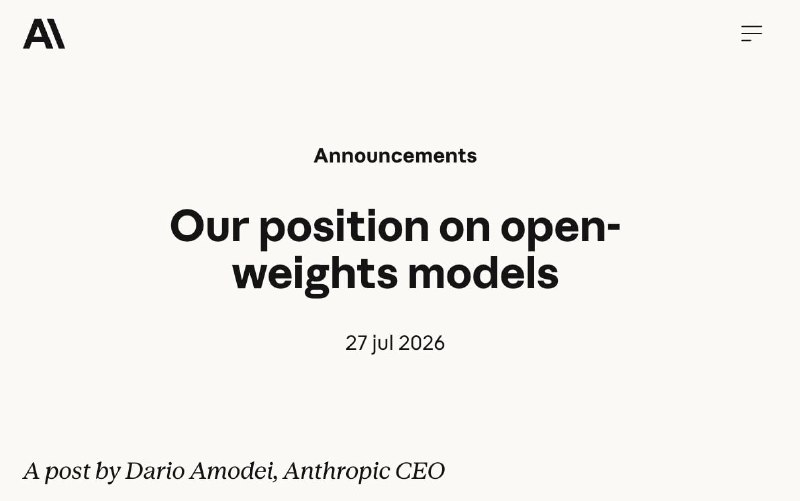
Anthropic has articulated its stance on open weight AI models, highlighting significant risks and challenges associated with their use.
Anthropic Responds to Discussion on Open Weight Models
The articulated points are quite telling:
- Access to advanced chips for China must be restricted.
- There are concerns that China may gain a military advantage.
- Without American chips, China will not be able to surpass the USA.
- Distillation of large models needs to be limited.
- Mandatory safety checks are required for the most powerful models.
- Open models carry more risks.
- The democratization of AI does not necessarily provide defenders with more advantages than adversaries.
- Advanced models could simplify the execution of biological attacks.
Thus, Anthropic responded to a letter signed by NVIDIA, Microsoft, The Linux Foundation, Google, and other companies and organizations.
Why it matters
AnalysisThis stance from Anthropic underscores the importance of controlling AI technologies, especially in the context of global security. The risks associated with open models could have serious implications for international stability.
Discuss in community
Share your questions and insights with developers
Related in Ecosystem
Practical guides, core terminology, and agent skills
AI Radar: GPT-6.1 Terra, Gemini 4 Carbon, Mistral Large 4 and OpenAI/Anthropic pricing changes
A roundup of recent AI news: new LLM releases, OpenAI and Anthropic subscription changes, world models, video generation, and research updates.
Claude Becomes Smarter
Claude becomes smarter, indicating possible improvements in the model's capabilities.
Claude Haiku (Fast Compact Models by Anthropic)
The most compact and fastest model in the Anthropic lineup, designed for lightning-fast responses, mass text classification, data extraction, and agent routing at minimal cost.
Claude Opus (Flagship AI Model by Anthropic)
The most powerful heavyweight model in the Anthropic family, designed for complex philosophical and scientific analysis, multi-layered text generation, and deep contextual understanding.