Anthropic releases Haiku 5.5: a 75% cheaper model that outperforms GPT-6 Luna
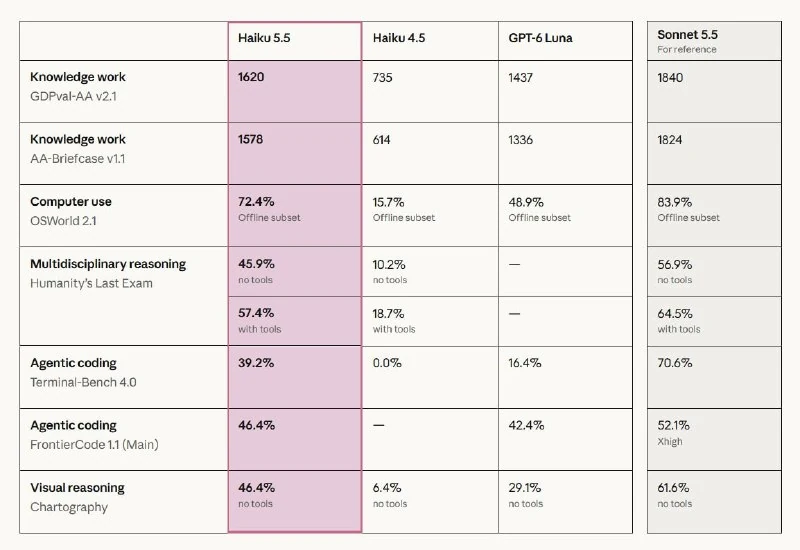
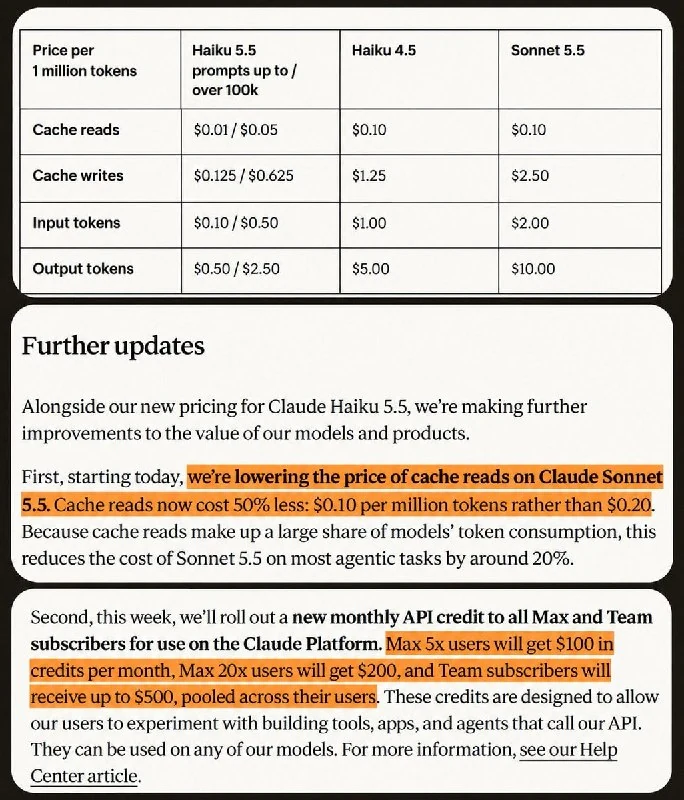
Anthropic’s new Haiku 5.5 model costs about 75% less than Haiku 4.5, offers configurable reasoning depth, and is designed for fast tasks and subagent workflows.
Anthropic released Haiku 5.5, a model that is approximately 75% cheaper than Haiku 4.5 and reportedly outperforms GPT-6 Luna.
- Faster and smarter than Haiku 4.5
- Configurable reasoning depth
- Built for quick tasks and subagent workloads
For requests up to 100,000 tokens, pricing matches Luna, but Haiku 5.5 fully surpasses it in capabilities.
Anthropic also cut Sonnet 5.5 caching prices by half and now provides monthly API credits:
- Max 5x — $100
- Max 20x — $200
- Team — up to $500 for all team users
Why it matters
AnalysisThe release strengthens Anthropic’s position in the low-cost, high-speed AI model segment, while cheaper caching and recurring API credits reduce friction for developers and teams running agentic workloads.
Discuss in community
Share your questions and insights with developers
Related in Ecosystem
Practical guides, core terminology, and agent skills
Claude Haiku (Fast Compact Models by Anthropic)
The most compact and fastest model in the Anthropic lineup, designed for lightning-fast responses, mass text classification, data extraction, and agent routing at minimal cost.
Claude Opus (Flagship AI Model by Anthropic)
The most powerful heavyweight model in the Anthropic family, designed for complex philosophical and scientific analysis, multi-layered text generation, and deep contextual understanding.
Thinking Machines releases Inkling 2 Mini, an open-weights model for local coding
Thinking Machines has released Inkling 2 Mini, an open-weights transformer with a cyclic architecture that can run locally on a Mac and was used to build a flight simulator offline.
Part II. AI Agent Architecture: From Model to Memory and Tools
A deep engineering dive: tokenization, KV-cache, sampling determinism, the training stack, quantization, context engineering, the safety stack, production RAG, ReAct, and multi-agent swarm systems.