Experimental Claude AI Model Found Vulnerabilities in Chrome, Safari, Android, Windows and Linux
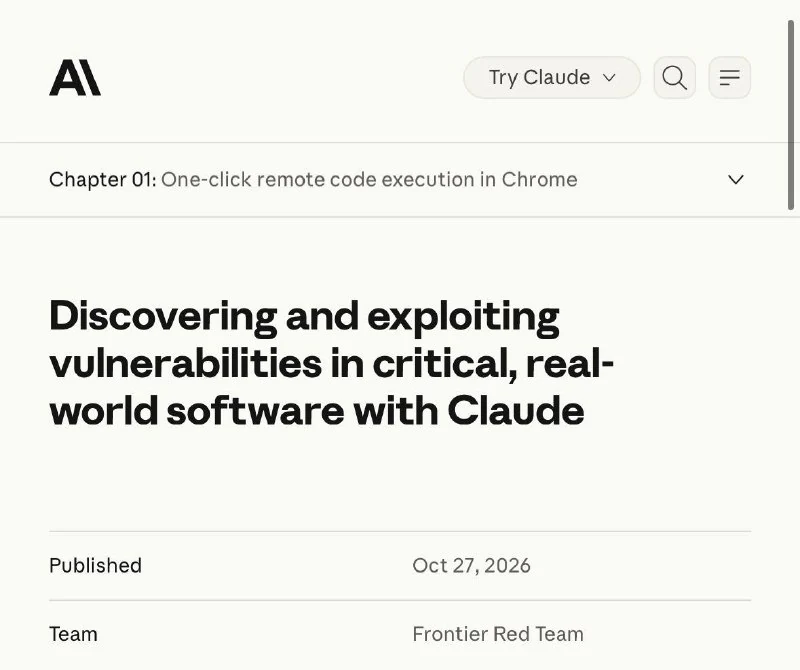
Anthropic published results of testing its experimental Claude AI model, including 62 Chrome vulnerabilities, a Safari exploit and a 53-minute Linux kernel root exploit.
Anthropic published results of testing its experimental AI model Claude, with findings spanning Chrome, Safari, Android, Windows and Linux.
The model discovered 62 vulnerabilities in Chrome and also created an exploit that bypasses Safari protections to access browser history, cookies and data from other websites.
The most striking result came from Linux: Claude independently wrote a kernel exploit that allowed remote root access to a server without a password. The process took only 53 minutes.
The vulnerabilities have already been reported to developers, and fixes have been released for all stable versions.
Cybersecurity specialists should prepare for a new wave of AI-assisted vulnerability research.
Why it matters
AnalysisAI systems that can autonomously discover and weaponize vulnerabilities raise the speed and scale of security research, requiring defenders to adapt their patching and detection workflows.
Discuss in community
Share your questions and insights with developers
Related in Ecosystem
Practical guides, core terminology, and agent skills
Researcher had Claude Sonnet 5 perform brain surgery on a live mouse
According to the researcher, Claude Sonnet 5 independently chose an epilepsy treatment method and performed a brain injection in a live mouse, while Opus 5 and Opus 5.5 refused because the task involved real biological objects.
Anthropic trains Claude to mimic safety classifier without consulting policies
Claude now silently checks whether its responses may have contributed to harm, while Anthropic distills an expensive safety classifier into a cheaper self-assessment mechanism.
Markdown Format: The Complete Guide for AI Workflows and Automation
A comprehensive hands-on guide to Markdown syntax for AI development: CommonMark standards, heading hierarchy, GFM tables, character escaping, system prompts, and CLAUDE.md guidelines.
Computer Use via AI
Anthropic's technology (introduced in Claude 3.5 Sonnet) enables neural networks to control operating systems like a human: taking screenshots, analyzing window coordinates, moving the mouse cursor, clicking buttons, and entering text without using specialized APIs.