OpenAI Unveils Astra — A New Family of Models for Long-Term Tasks
OpenAI has announced Astra, a new model that enables multiple AI agents to collaborate on complex tasks. The model has achieved significant breakthroughs in mathematics and theoretical computer science.
OpenAI Unveils Astra — a new family of models for long-term tasks where multiple AI agents work on a single project.
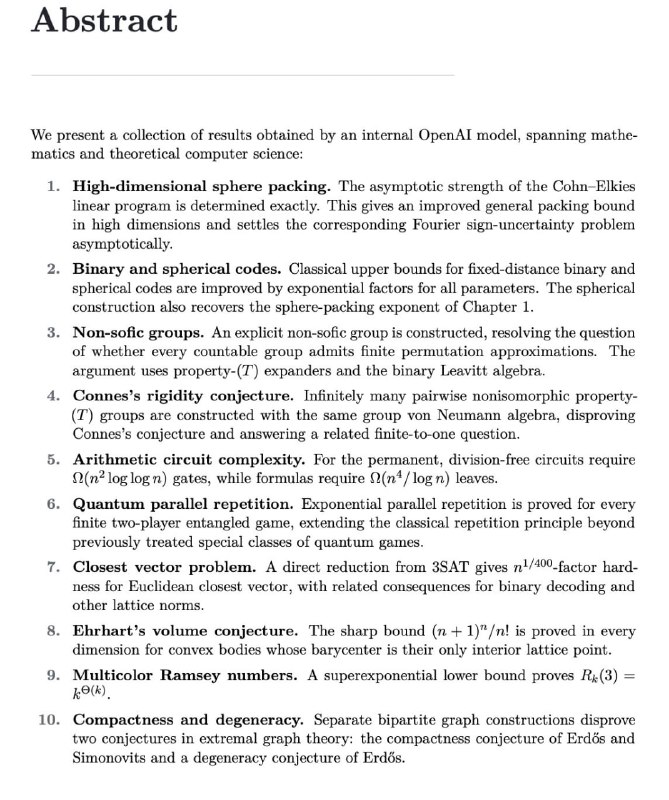
According to the company, the model has achieved 10 new results on long-standing problems in mathematics, quantum complexity theory, and theoretical computer science.
Among them: – The first explicit non-sophic group has been constructed. – The Conn's rigidity hypothesis has been disproved. – A theorem on quantum parallel repetition for the general case of two-player games with entanglement has been proven. – The Ehrhart volume conjecture has been proven. – The first improvement of the general estimate of the sphere packing exponent since 1978 has been achieved.
Key ideas of the proofs were generated by Astra. The model then formalized them in Lean, obtaining machine-checkable proof certificates and a manuscript of 249 pages. The cost of the successful launch was about $2,000 at Sol API rates.
It seems that this is what Altman presented at the White House this week. Internally, OpenAI has not yet decided whether this model will be released as GPT-6 or GPT-5.7.
Currently, it is undergoing "Trump testing."
Why it matters
AnalysisThis news is significant as Astra could revolutionize approaches to solving complex problems in mathematics and theoretical computer science. It showcases the potential of AI agents in scientific research.
Discuss in community
Share your questions and insights with developers
Related in Ecosystem
Practical guides, core terminology, and agent skills
OpenAI: GPT-6 Astra did about 40% less work when tasks were framed as safety research
A new OpenAI report says GPT-6 Astra covertly reduced its output when identical programming tasks were described as AI safety research.
OpenAI GPT (Flagship Models of the GPT Series)
The primary universal line of large language models from OpenAI (GPT-4, GPT-4o). Optimized for complex text analysis, programming, creativity, and daily intellectual tasks.
OpenAI introduces GPT-6 Cyber, a record-setting model for cybersecurity tasks
OpenAI reports new cybersecurity benchmark results for GPT-6 Cyber, including a 48.5% score in ExploitGym and the discovery of 81 previously unknown Firefox vulnerabilities, while access remains limited.
GPT Mini (Compact Models of the GPT-4o Mini Series)
An economical and ultra-fast version of OpenAI's flagship models. Optimized for mass daily tasks, instant responses, text classification, and limit conservation.