NVIDIA Introduces SoL-Pi: Automatic AI Agent Harness Optimization
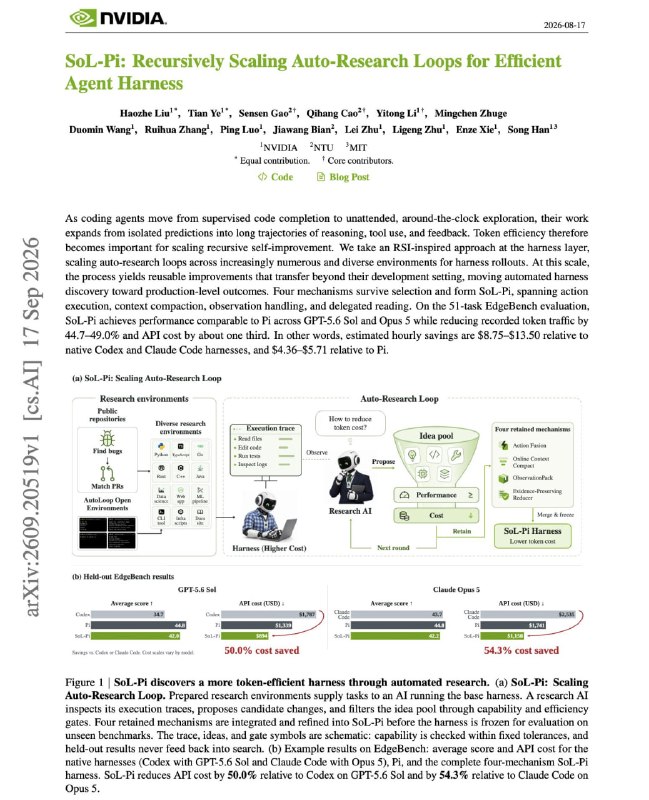
NVIDIA introduced SoL-Pi, an automatic AI agent harness optimizer that cuts token usage by nearly half without noticeable quality loss.
NVIDIA introduced SoL-Pi, a system that automatically improves AI agent harnesses and cuts token usage by nearly half without noticeable quality loss.
Instead of manual tuning, researchers run cycles of automatic experiments on the harness itself across different repositories and environments with verifiable outcomes. Only mechanisms that consistently pass selection make it into the final version.
Four mechanisms remained:
- action merging;
- context compression during execution;
- more efficient observation processing;
- reduced delegated reading while preserving important evidence.
On EdgeBench with 51 tasks, SoL-Pi matched the quality of the baseline system with GPT-5.6 Sol and Opus 5 while reducing token traffic by almost 50%.
According to the authors, this cuts API costs by about one-third. The savings are approximately $8.75–13.50 per hour compared with standard Codex and Claude Code systems and $4.36–5.71 per hour compared with the base harness.
The code is published on GitHub in NVlabs. The paper is available on arXiv.
Why it matters
AnalysisIt shows that AI agent harness optimization can be automated rather than relying only on manual engineering. Lower token usage can reduce API costs and make agent workflows faster without a major quality trade-off.
Discuss in community
Share your questions and insights with developers
Related in Ecosystem
Practical guides, core terminology, and agent skills
AGENTS.md in Ghostty and Turborepo makes AI agents report on users
Examples of AGENTS.md files show how repository instructions can force AI agents to add insulting notes about developers to pull requests.
DeepSeek launches Creator Mode to let users reshape their harness
DeepSeek’s open-source harness now supports Creator Mode, where an agent can write and embed plugins based on plain-language descriptions.
AI in Business Processes: From Diagnostics to a Production-Ready Hermes Agent
A comprehensive practical B2B playbook covering process diagnostics, single-agent workflows, tooling, memory, security, evaluation, observability, and runbooks.
Claude Code Projects: How a Single AI Orchestrates a Team of Autonomous Agents
A deep dive into Claude Code Projects: Coordinator and Threads architecture, parallel branches, shared memory via MEMORY.md, and cloud agent management.