mold 3.0 drops C++ for Rust
The mold linker for Linux has been fully rewritten in Rust in version 3.0, keeping the same speed and command compatibility while improving safety.
A developer tool for Linux has fully dropped C++ in favor of Rust.
This is about mold, a linker that speeds up program builds by combining compiled code into a finished program.
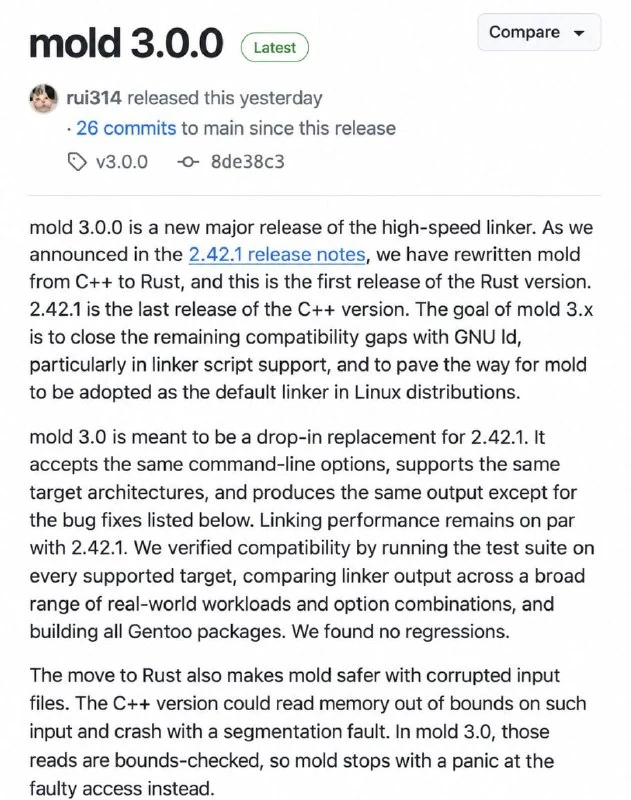
Version 3.0 is fully rewritten in Rust. According to the developers, it runs just as fast as the C++ version.
The commands and supported architectures remain unchanged. To verify compatibility, the developers even built all Gentoo packages and reported no regressions.
During the rewrite:
- CMake was replaced with Cargo;
- the dependency on Intel oneTBB was removed;
- bounds checking was added when handling damaged files.
The developers now want to eliminate the remaining incompatibilities with GNU ld so that Linux distributions can use mold as the default linker.
Release link: mold 3.0.0.
Why it matters
AnalysisThe Rust rewrite reduces memory-safety risks and simplifies the build system. If mold becomes the default linker, it could make package builds faster across many Linux distributions.
Discuss in community
Share your questions and insights with developers
Related in Ecosystem
Practical guides, core terminology, and agent skills
Cheetah: Rust backend for local language model inference with minimal memory use
Open-source Rust backend Cheetah reduces idle RAM usage for small local language models to tens of megabytes, making them runnable on older laptops.
Fast Anything speeds up apps without rewriting everything in Rust
New open-source tool Fast Anything identifies performance bottlenecks and rewrites only the slowest code paths in Rust.
Hermes Profile: DevOps Engineer & Cloud Infrastructure
Hermes systems and DevOps engineering profile: Linux server hardening, Docker containerization, CI/CD automation pipelines, observability, and security.
How to Run DeepSeek-R1 Locally for Free on Mac, Windows, and Linux
Tired of the limitations of cloud services and constant payments for DeepSeek-R1 API? You are not alone. Many developers, AI users, and researchers want complete control over their data and workflows.