Claude now self-assesses potentially harmful requests
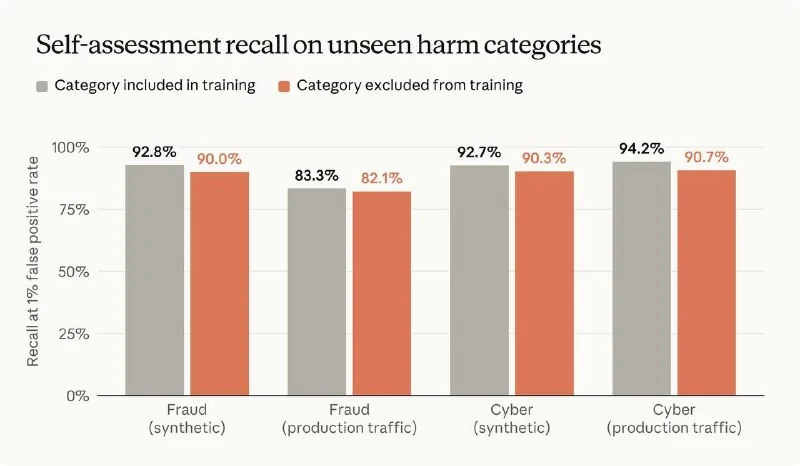
Anthropic says Claude receives a hidden instruction after each response to briefly evaluate whether the conversation contained a potentially harmful request.
Immediately after answering, the model receives a hidden instruction and briefly assesses whether the conversation contained a potentially harmful request.
The method is already active in all models starting with Fable 5 for most traffic, except for clients with zero data retention. On its own, it does not block anything; it only flags dialogues.
Why it matters
AnalysisIt shows how AI providers are embedding internal safety review directly into model responses, creating a lightweight monitoring layer without immediate blocking.
Discuss in community
Share your questions and insights with developers
Related in Ecosystem
Practical guides, core terminology, and agent skills
Anthropic removes five-hour Claude usage limits for Ultra subscribers
Anthropic is dropping five-hour usage limits for Claude, but only for verified Ultra subscribers, while renaming its Max tiers without changing prices.
Experimental Claude AI Model Found Vulnerabilities in Chrome, Safari, Android, Windows and Linux
Anthropic published results of testing its experimental Claude AI model, including 62 Chrome vulnerabilities, a Safari exploit and a 53-minute Linux kernel root exploit.
Computer Use via AI
Anthropic's technology (introduced in Claude 3.5 Sonnet) enables neural networks to control operating systems like a human: taking screenshots, analyzing window coordinates, moving the mouse cursor, clicking buttons, and entering text without using specialized APIs.
Constitutional AI (RLAIF)
A behavior alignment method developed by Anthropic (creators of Claude). Instead of relying on millions of hours of human labor, the model critiques and corrects its own responses based on a clear set of ethical principles ('Constitution').