The artificial intelligence landscape is rapidly transitioning from generic conversational chatbots toward specialized agentic architectures and high-impact practical utilities. Modern AI agents no longer suffice with merely generating text—they require telephone endpoints to communicate with the real world, access to thousands of external APIs, structured long-term memory, and shared visual workspaces alongside human teams.
In this monthly digest, we have selected the top five most impactful product launches from a field of 29 new releases, addressing distinctly different engineering and productivity requirements.
1. Introduction and Tool Selection Criteria
The generative AI sector is maturing: instead of redundant front-end wrappers for base foundation models, builders are launching essential infrastructure components that turn isolated models into autonomous digital collaborators.
1.1. Ecosystem Evolution: From Chatbots to Specialized Agents
While previous AI interactions were confined to chat bubbles, today's driving value proposition is Agency—the capacity to interact autonomously with the external digital environment: triggering payment gateways, receiving verification SMS codes, querying enterprise knowledge graphs, and coordinating workflows within multi-agent teams.
1.2. Selection Criteria for the Top 5 Out of 29 Launches
Our selection framework evaluated candidate tools across three primary criteria:
- Immediate Practical Utility: Directly resolving tangible friction points for developers and knowledge workers today.
- Architectural Novelty: Delivering genuine technical innovation rather than white-labeling existing open-source packages.
- Accessibility and Governance: Offering open-source software (OSS) distributions or self-serve APIs without restrictive procurement barriers.
2. Monid — 1,800+ APIs for AI Agents via a Single Key
Equipping an autonomous agent with dozens of external tools traditionally entails managing separate developer accounts, funding disparate pre-paid balances, and writing custom authentication middleware.
 1. Monid — 1800+ APIs for AI Agents via a Single Key — illustration 1
2.1. The "OpenRouter for Tools" Concept and Unified Balance
Monid provides an architectural paradigm analogous to OpenRouter, but focused on third-party tool execution rather than LLM inference:
- Single API Key and Shared Balance: One integration unlocks immediate programmatic access to over 1,800 external tools and services;
- Granular Pay-as-You-Go Billing: Pay-per-call pricing starting at $0.0013 without mandatory monthly SaaS commitments;
- Standardized Schema: Delivers uniform JSON Tool Call signatures compatible with any major agent framework.
Monid consolidates search engines, web scraping, financial ticker feeds, social media sentiment analysis, and media generation behind one unified gateway.
2.2. Practical Automation Scenarios and Target Audience
- Autonomous Research Agents: Concurrently pulling real-time equities pricing, monitoring competitor domains, and analyzing audience sentiment without bespoke connector maintenance.
- Lead Generation Pipelines: Sourcing prospects, verifying email deliverability, and enriching firmographic profiles in a single workflow.
- Target Audience: Autonomous agent developers, AI product teams, and enterprise automation engineers.
3. Dial — Phone Numbers and Mobile Communications for Agents
Despite the dominance of internet protocols, mission-critical business communications and user identity validations remain tethered to standard telephony and SMS.
3.1. Instant Number Provisioning, Calls, and SMS Capabilities
Dial gives software agents programmatic access to global telecom infrastructure:
- Instant provisioning of authentic phone numbers in approximately 10 seconds via API;
- Full-duplex voice calling with real-time speech-to-speech interaction;
- Bi-directional SMS delivery across more than 200 countries;
- Native integration with Apple iMessage ecosystems;
- Automated reception and parsing of one-time password (OTP) verification codes.
3.2. Two-Line Integration and Business Use Cases
Injecting Dial into frontier agent runtimes (such as Claude Code, Codex, or Windsurf) requires just two lines of system guidance:
Key Business Applications:
- Autonomous concierge agents capable of confirming restaurant reservations and courier deliveries over voice;
- Automated verification pipelines handling phone-based 2FA during web testing;
- Real-time incident escalation dispatching voice calls to on-call engineers.
4. HydraDB OSS — Graph Memory and Ontologies for AI
As AI applications expand in scope, linear chat history fails to maintain context. Agents require permanent, relational memory architectures that track not just raw text, but complex semantic connections.
 Target audience — illustration 2
4.1. Sub-200ms Context Storage Architecture
HydraDB OSS is an open-source graph database engine purpose-built for AI application memory:
- Deployed directly on top of commodity object storage (AWS S3, Google Cloud Storage);
- Delivers query execution latency under 200 milliseconds;
- Maintains relational entity networks: "Who owns this initiative", "What constraints bind this customer", "How does this relate to past projects".
4.2. Long-Term Entity Relationships and Target Audience
- Dynamic Ontologies: Structuring unstructured institutional knowledge into a live relational graph.
- Shared Multi-Agent State: Allowing distinct agent processes to read, query, and synchronize updates to a single world model.
- Target Audience: Architects building sophisticated long-term memory systems and enterprise-grade Retrieval-Augmented Generation (RAG).
5. Doop — Shared Canvas for Humans and Multi-Agent Teams
Standard chat interfaces are poorly equipped for concurrent multi-agent collaboration, requiring human users to manually copy-paste intermediate outputs across disconnected windows.
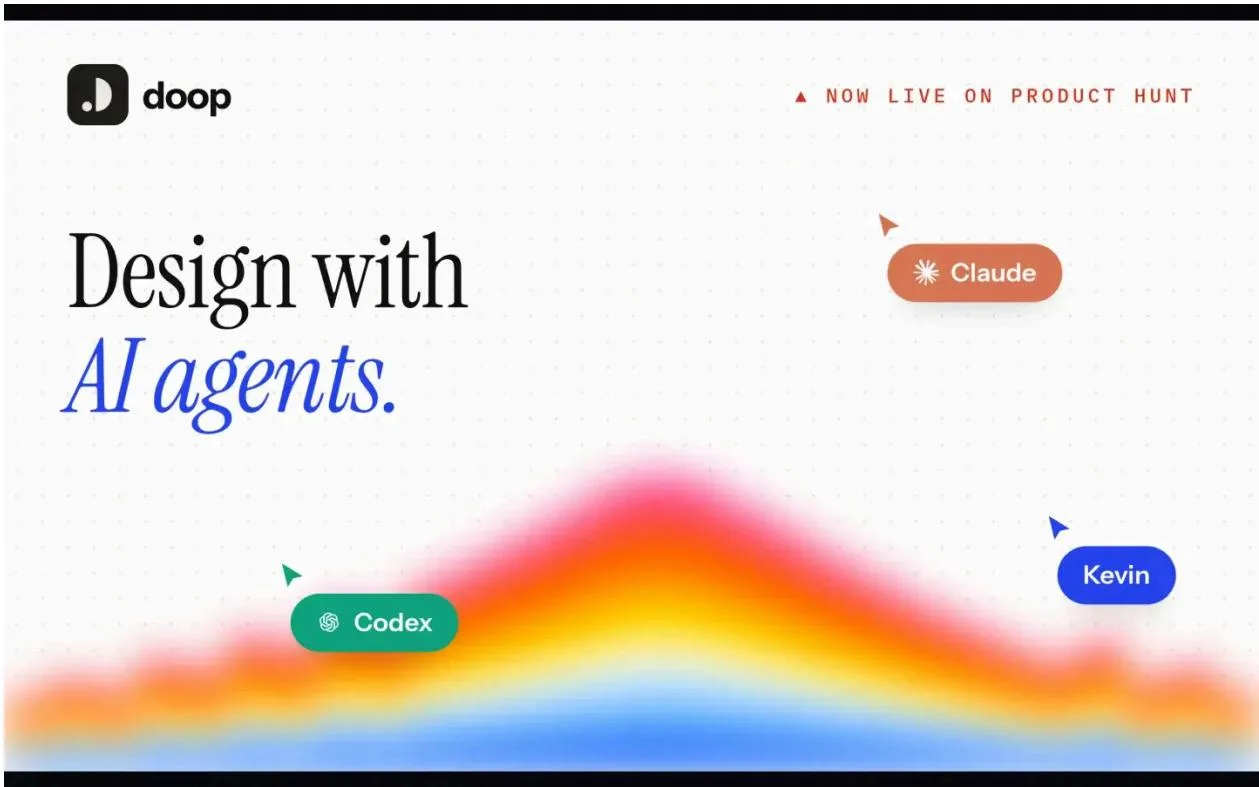 4. Doop — Shared space for humans and multiple AI agents — illustration 3
5.1. Infinite Visual Workspace for Claude, Codex, and MCP
Doop re-envisions human-AI collaboration onto an infinite visual canvas where humans and models from different providers work simultaneously in real time:
- Seamless compatibility with Claude, OpenAI Codex, and custom Model Context Protocol (MCP) agents;
- Spatial transparency: watch code files, UI mockups, and architectural drafts generate concurrently across the board;
- Fully open-source codebase supporting Bring-Your-Own-Key (BYOK) configurations.
5.2. Unified Project Memory and Cross-Verification of Solutions
Establishes the overarching creative vision on the canvas, organizes layout hierarchy, and makes definitive executive decisions.
6. Orato — Personal On-Device AI Speech Coach
In contrast to developer infrastructure tools, Orato addresses an intimate personal development challenge directly on consumer mobile hardware.
6.1. Analyzing Tempo, Pauses, and Filler Words with Apple Intelligence
Orato transforms the iPhone into a real-time speech and communication coach:
- Evaluates pacing, cadence, and vocal fluidity across short 30- to 90-second speech drills;
- Generates precise transcripts highlighting crutch words ("um", "ah", "like") and excessive pauses;
- Measures vocabulary breadth and sentence complexity.
Data Privacy: Powered by Apple Intelligence, all audio recording and transcription processing takes place locally on-device. Your vocal biometric data never leaves your hardware.
6.2. 90-Second Practice Sessions for Pitches and Interviews
- Rapid Rehearsal: Practice answers to standard executive interview prompts in under 90 seconds;
- Pitch Refinement: Polish opening statements prior to high-stakes sales presentations;
- Target Audience: Founders, executives, team leads, and professionals seeking confident, polished verbal delivery.
7. Comparative Matrix and Key Takeaways
Each featured tool occupies a distinct, non-overlapping tier within the modern artificial intelligence technology stack.
7.1. Consolidated Overview of the 5 Innovative Services
| Service | Category | Core Competitive Edge | Pricing & Distribution | Ideal Target Profile |
|---|---|---|---|---|
| Monid | API Gateway | 1,800+ external tools under 1 key | Pay-as-you-go (from $0.0013) | Autonomous agent builders |
| Dial | Telephony | Real phone numbers in 10s (Voice/SMS/iMessage) | Free starter credits available | Customer-facing voice/SMS agents |
| HydraDB OSS | Graph Database | Persistent graph memory with <200ms latency | Open Source (Apache/MIT) | Enterprise RAG and memory engineers |
| Doop | Collaboration | Infinite canvas for human and multi-agent teams | Open Source (BYOK API keys) | Product design and engineering squads |
| Orato | Mobile Assistant | Private speech evaluation via Apple Intelligence | Free iOS Application | Public speakers, managers, founders |
7.2. The Core Trend: Expanding Agent Autonomy and Practical Utility
This month's selections highlight an undeniable industry shift: the era of competing over raw text generation has passed. The most impactful innovations empower AI systems with operational agency—connecting them to physical telecommunications, third-party APIs, structured memory, and fluid collaborative workspaces.