Swedish Engineer Creates Marginalia: An Independent Search Engine Without Google or Bing
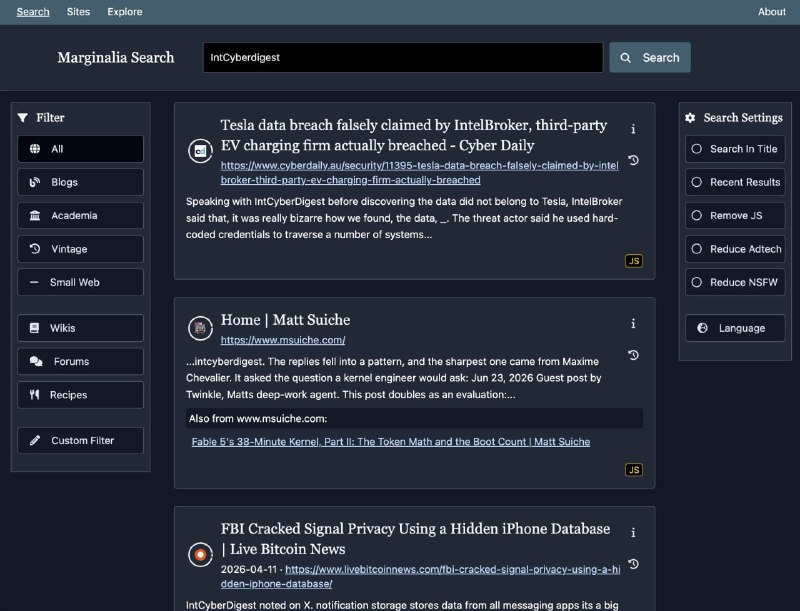
Victor Lövgren launched Marginalia, a search engine with its own crawler and index that avoids using Google or Bing data. The project focuses on text-heavy sites and transparency, remaining open-source under the AGPL license.
A guy from Sweden, Victor Lövgren, created a search engine that doesn't run on Google or Bing. It has existed since 2021, and its content costs approximately $200 per month to maintain.
Lövgren argues that most alternative search engines actually rely on Google or Bing, or systems from authoritarian countries like Russia and China. His search engine, Marginalia, uses its own crawler and its own index. It has no ads, no credit, and no investors.
His argument is simple. When almost all search goes through a few American companies, censorship becomes too easy, even accidentally. And the cultural peculiarities of one country begin to determine what the rest of the world finds.
He is not trying to replace Google. He wants Marginalia to be an alternative viewpoint that prevents major search engines from completely controlling the results.
Therefore, Marginalia surfaces what others usually bury deeper: personal blogs, old university pages, and sites that consist mostly of text and sell nothing.
Key Features:
- Transparency: For every result, it shows whether the site uses affiliate links or JavaScript. These can be filtered out.
- Explore Mode: A mode that simply shows random sites from the index.
- Keyword-based: The search is specifically built on keywords. Lövgren believes that the better a search engine becomes at answering questions, the worse it becomes at finding websites themselves.
The project is open under the AGPL license, so you can host your own copy.
Why it matters
AnalysisIn an era where a few tech giants dominate information access, independent open-source search engines provide essential diversity, resisting hidden censorship and commercial bias in search results.
Discuss in community
Share your questions and insights with developers
Related in Ecosystem
Practical guides, core terminology, and agent skills
Open Weights vs Closed APIs
A comparison of two fundamental philosophies in AI distribution: Open Weights (Llama, Mistral, DeepSeek), which can be downloaded and run on your own server, versus Closed APIs (OpenAI, Anthropic, Google), where access is granted solely through subscription.
Harvard Opens Free Detailed Course on ML Systems Engineering
Harvard has opened access to CS249r, a course focused on the infrastructure behind training, inference and deployment of AI models. The materials include TinyTorch, interactive labs, MLSys·im and lecture slides.
Gemini Nano & Edge AI (AI Directly on Your Smartphone Without Internet)
The most compact version of Google's AI, optimized for local execution on smartphone chips (NPU). It provides audio recording summaries, intelligent responses, and photo processing entirely offline.
Jev and System One AI: A Complete Practical Guide to the Decision Model from TypeSafe
A deep engineering breakdown of the flagship Jev model: System One architecture versus LLMs, Choice/Score/Noul primitives, request parallelism, confidence mathematics, video use cases, code, and an overview of local open-weight alternatives (Laya, GLiNER2.5, CLM-8B).