Official Release of TypeScript 7
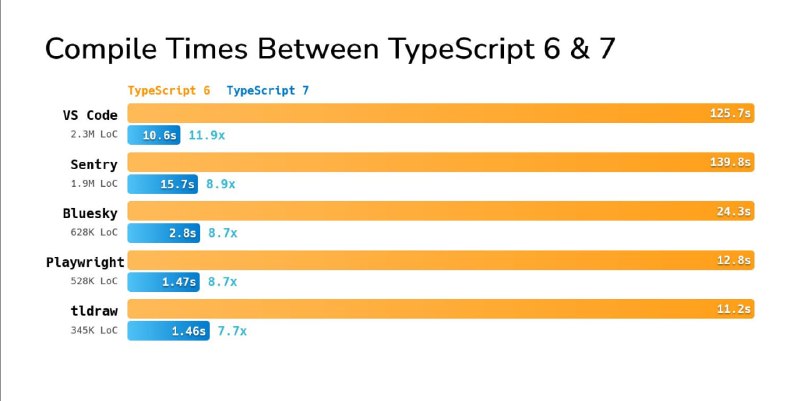
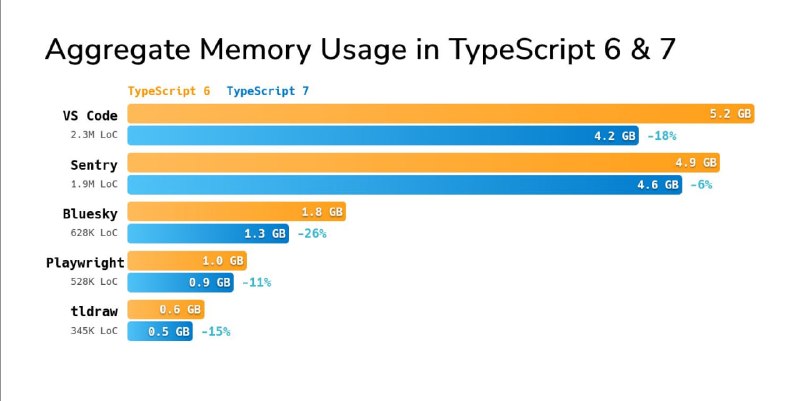
TypeScript 7 has officially launched with new features that significantly enhance performance. This is an important step in the evolution of the programming language.
Official Release of TypeScript 7
TypeScript 7 has been ported to native code with support for parallel execution, allowing it to run up to 10 times faster on many projects.
What has changed:
- Faster compilation and type checking;
- Reduced memory consumption;
- Fewer crashes in the editor;
- Faster CI;
- More responsive VS Code, Visual Studio, and other IDEs;
- Official support for LSP;
- New --watch mode based on the Go port of the watcher from Parcel;
- Automatic release of unused type checker state after idle time.
All familiar editor features remain in place: auto imports, Find All References, hover hints, inlay hints, code lenses, linked editing, semantic highlighting, import sorting, and much more. Now it works noticeably faster.
New experimental flags for parallelism:
--checkers- controls the number of workers for type checking;--builders- manages parallel builds of projects.
For those still needing the TypeScript 6 API, a separate package has been introduced:
/typescript6- it installs alongside TypeScript 7 and provides a separate binarytsc6, without conflicts with the regulartsc.
How to install TypeScript 7:
npm install -D typescript
And run it as usual:
npx tsc
In short, TypeScript 7 is a significant step towards a faster, more stable, and enjoyable developer experience, especially on large codebases and in teams where every delay in CI and the editor is felt.
Why it matters
AnalysisThis release greatly enhances development performance, which is critical for large projects. TypeScript 7 provides better stability and speed, improving team efficiency.
Discuss in community
Share your questions and insights with developers
Related in Ecosystem
Practical guides, core terminology, and agent skills
Jev and System One AI: A Complete Practical Guide to the Decision Model from TypeSafe
A deep engineering breakdown of the flagship Jev model: System One architecture versus LLMs, Choice/Score/Noul primitives, request parallelism, confidence mathematics, video use cases, code, and an overview of local open-weight alternatives (Laya, GLiNER2.5, CLM-8B).
Claude Code Guide: Setup for Agentic Programming (Beginner-Friendly)
A comprehensive practical guide to setting up Claude Code: CLI installation, CLAUDE.md and settings.json configuration, permission matrices, automated hooks, custom /truth command, and subagents.
AI Refactoring: Safely Refreshing Legacy Code Without Changing Its Logic
A methodology for improving the internal structure, readability, and performance of existing Legacy Code using language models without altering its external behavior. It enables breaking down large spaghetti functions into neat modules and converting old JavaScript to modern TypeScript.
Hard Compiler & Linter Gates
The practice of immediate and irreversible rollback or blocking of changes by the AI agent if the compiler (tsc, rustc) or fast linter (Biome, Ruff) returns a non-zero exit code.