Claude computed a nine-loop amplitude in N=4 SYM
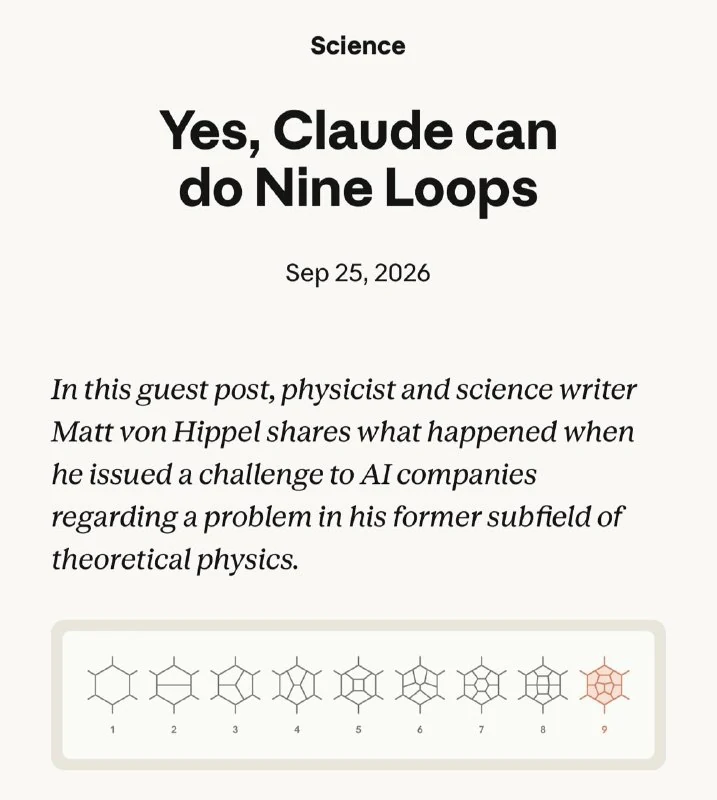
A previously inaccessible nine-loop amplitude was computed with Claude and independently confirmed.
Claude computed a nine-loop amplitude in N=4 SYM. Experts had long considered this task too difficult for direct calculation.
Scattering amplitudes are formulas physicists use to predict how likely particles are to interact in a given way. Exact values are almost impossible to compute, so they are approximated up to a certain number of loops: the more loops, the more precise the answer, but the faster the computational complexity grows.
Most real amplitudes have been computed only up to two or three loops. New calculation methods are usually tested on simplified toy theories, such as supersymmetric Yang-Mills theory (N=4 SYM). Even there, the previous record was eight loops, while the ninth was considered too difficult for a direct calculation.
In August, physicist and blogger Matt von Hippel publicly challenged AI companies to try solving the problem on a typical academic budget. A month later, two physicists from Anthropic returned with a result.
They ran Fable 5.1 inside Claude Science, gave it a single line stating the problem, and then mostly wrote things like “I’m going to sleep, keep going.” In the end, Claude computed the amplitude in two different ways, each costing roughly $1–2k. The actual computation was about $100, plus a week on 96 CPUs; the rest was the model’s work.
Dixon checked and confirmed the result. The most impressive part was not the volume of computation, but that the model assembled a very fragile calculation scheme from scratch for a task where any small mistake breaks everything. He said that now Claude “understands their papers better than anyone except the coauthors.”
Almost simultaneously, a group led by Sun He from the Chinese Academy of Sciences independently obtained the main part of the same result using GPT-6, but Anthropic was still first to publish the main solution.
Why it matters
AnalysisIt suggests AI can assemble fragile analytical pipelines from scratch, not just accelerate known computations. For theoretical physics, this may expand the set of problems accessible to direct calculation.
Discuss in community
Share your questions and insights with developers
Related in Ecosystem
Practical guides, core terminology, and agent skills
Anthropic releases Claude Fable-5.2: pricing, limits and AI R&D restrictions
Anthropic introduced Claude Fable-5.2, officially cheaper than the previous version but more expensive than Opus 5.5. User reports point to separate limits and training caps for AI R&D tasks.
Anthropic Releases Claude Fable 5.2
Anthropic has released Claude Fable 5.2, a new AI model that tops Artificial Analysis and Vals AI rankings while offering faster generation and lower API pricing.
Claude + Excel for Logistics: 10 Ready-to-Use Scenarios for Rate, OTD, and Cost Audits
A practical B2B playbook on integrating Claude with Excel: ready-made system prompts, formulas, and algorithms for analyzing freight variance, OTD, suppliers, and inventory.
Claude + Notion for Business: Automating CRM, Tasks, and Content in 30 Minutes
A step-by-step B2B guide to integrating Claude with Notion: ready-to-use database architecture, triggers, formulas, automation scripts, and prompt templates.