Free Course: Build a DeepSeek-style Model from Scratch
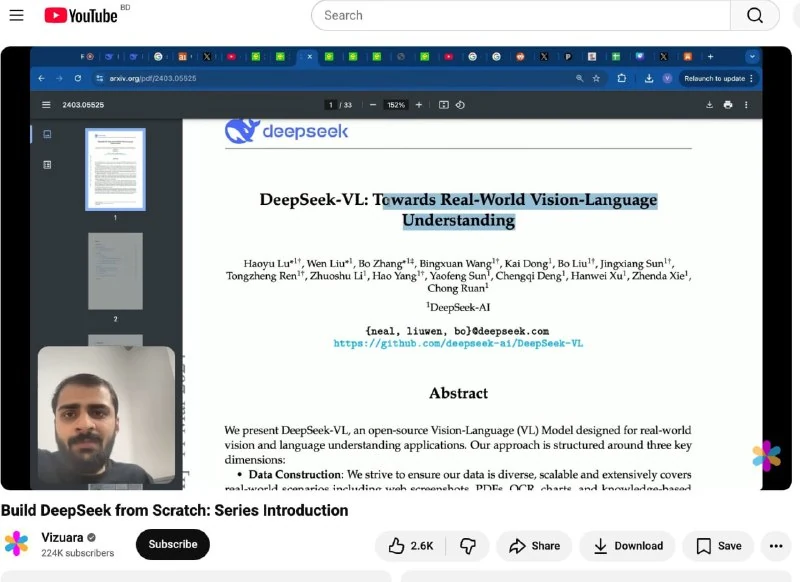
An author released a free 16-hour YouTube course that step-by-step explains how to build an AI model in the style of DeepSeek from scratch, covering Attention architectures and MoE.
Build a DeepSeek-style Model from Scratch
An author has published a free 16-hour course on YouTube, where they break down the process of building a Large Language Model (LLM) from scratch step by step. The material covers everything from theoretical foundations and scientific paper analysis to writing full functional code.
What's inside the course:
- Attention mechanism with a detailed and clear explanation
- Multi-Head Latent Attention
- Grouped Query Attention
- Positional Encodings
- Mixture of Experts (MoE)
- And many other architectural components
All you need to complete the course is a laptop and consistency.
Why it matters
AnalysisThis is a rare example of deep technical education that opens the 'black box' of modern LLMs, allowing developers to understand the DeepSeek architecture at the code level, not just through the API.
Discuss in community
Share your questions and insights with developers
Related in Ecosystem
Practical guides, core terminology, and agent skills
Alibaba opens access to Qwen4-Max-Preview
Alibaba has made Qwen4-Max-Preview, an early version of Qwen 4, available for testing in Qwen Chat, Agent Mode, and via Alibaba Token Plan.
Google releases Gemini 4 Carbon
Google announced the Gemini 4 Carbon AI model and made it available to a wider audience, effectively limited to AI Ultra subscribers paying $250.
Part II. AI Agent Architecture: From Model to Memory and Tools
A deep engineering dive: tokenization, KV-cache, sampling determinism, the training stack, quantization, context engineering, the safety stack, production RAG, ReAct, and multi-agent swarm systems.
Hermes Profile: Educational Methodologist & Course Architecture
Hermes instructional design profile: curriculum engineering via Bloom's taxonomy, interactive microlearning, hands-on workshops, and course completion rate optimization.