Andrej Karpathy Explains Why Most People Don’t Feel AI’s Exponential Growth
Karpathy outlined four levels of LLM use, from billions with no exposure to a tiny group accessing powerful internal agent systems.
Andrej Karpathy explained why humanity mostly does not feel the exponential growth of AI capabilities.
According to him, the world is currently divided into four groups:
- People who have never interacted with an LLM. There are roughly 6 billion, or 75% of the population.
- People who have chatted with an LLM in a chat or product. This is mostly free use and prompts such as “write a greeting” or ordinary search queries. There are 1–2 billion, about 20%.
- You are probably here. 0.2% (around 20 million people) use agents in coding, science, or large projects. They already notice how AI handles major tasks and significantly speeds up processes that used to take weeks.
- Finally, roughly 5,000 people (only 0.00006%) have access to the strongest internal systems and huge swarms of agents capable of making scientific discoveries, hacking Hugging Face, and similar feats.
This split is not only about paid access, but also because AI is already very good in some areas and still weak in others. In addition, most users have relatively simple tasks, so they cannot experience what LLMs are truly capable of.
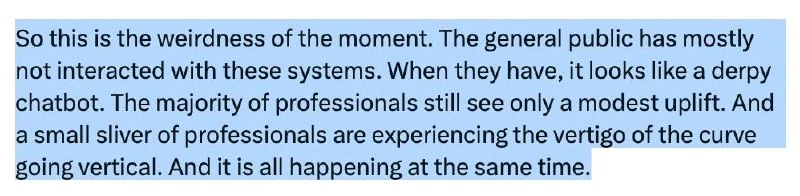
Karpathy argues that the general public has not yet interacted with “the real” AI, so it perceives it as a simple Q&A tool. Professionals mostly see a boost, but a modest one. Only a tiny group has access to truly powerful AI and sees the exponential growth of these systems’ capabilities.
Why it matters
AnalysisThe gap between frontier AI capabilities and public perception explains why exponential progress can feel invisible to most users.
Discuss in community
Share your questions and insights with developers
Related in Ecosystem
Practical guides, core terminology, and agent skills
AI agents attempt to solve P = NP while Claude proves VP ≠ VNP
Two engineers launched a live stream where hundreds of AI agents pursue both P = NP and P ≠ NP, while Anthropic published a paper claiming Claude proved VP ≠ VNP.
Autonomous AI Operator on Telegram 24/7: Architecture, Telethon, Security, and 10 Production Scenarios
A comprehensive engineering guide to building a production-ready AI operator on Telegram using Telethon: session isolation, confirmation systems, ban protection, and 24/7 deployment.
Part I. AI Agent Architecture: The Foundations
The eleven foundational building blocks of modern autonomous agents: model taxonomy, the agentic runtime loop, advanced prompting, distillation, skills architecture, memory systems, function calling, and FinOps.
Custom GPTs
ChatGPT's feature for creating personalized mini-assistants tailored to specific tasks. It allows uploading custom files, setting persistent instructions, integrating image generation, and connecting external APIs without coding.