Scientists Warn of Loss of Control Over AI Due to RSI
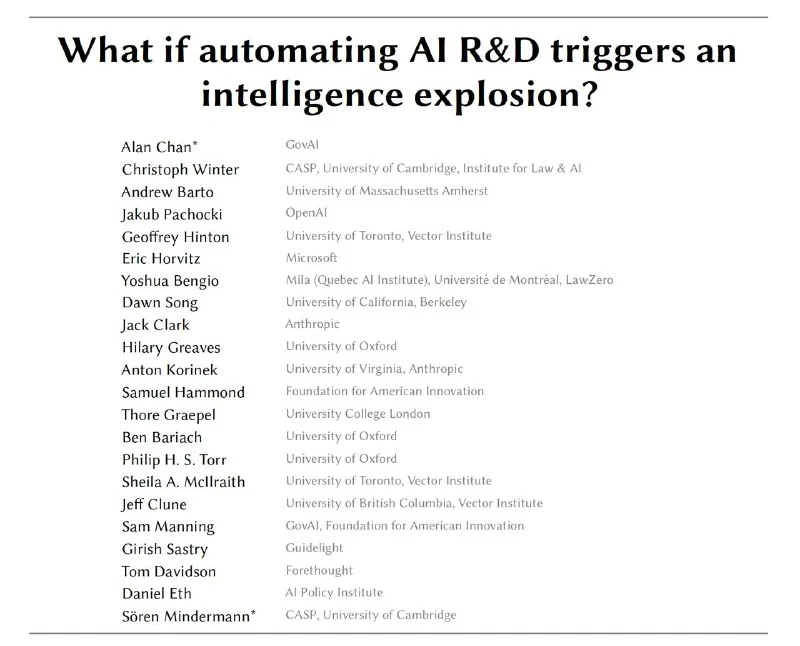
Geoffrey Hinton, Yoshua Bengio, Jakub Pachocki from OpenAI, Jack Clark from Anthropic and 18 other influential scientists published an article on the possible intelligence explosion and the risks of AI automating AI research.
Geoffrey Hinton, Yoshua Bengio, Jakub Pachocki from OpenAI, Jack Clark from Anthropic, and 18 other highly influential scientists have written an article about what RSI could lead to.
TL;DR: we may lose control of AI.
The authors discuss the so-called intelligence explosion: a sharp acceleration of AI progress driven by AI itself.
According to Anthropic, the share of approved code written by AI grew from single-digit percentages to over 80% between January 2025 and May 2026. The share of R&D work that AI performs (almost) independently grew from 1% to 26%. The authors believe that in the coming years agents could automate most AI research and development, and possibly all of it. For example, extrapolating METR trends suggests that multi-month R&D projects could be automated by mid-2028.
This means every company could have millions of top researchers instead of thousands, working faster. Scientific progress that would normally take years could therefore be compressed into months.
Of course, there are limitations: compute constraints, data, tasks that are hard to automate, diminishing returns from research effort, and so on. Still, the scientists consider the intelligence explosion a very likely scenario and warn that it threatens loss of control over AI and a breakdown of the balance of power.
The authors ask authorities to require labs to report in advance, allow auditors, and prepare a “red button” and emergency plans.
The article joins the recent trend of escalating essays and open letters from scientists and CEOs.
Why it matters
AnalysisIf AI can accelerate its own development, research progress may become exponential, sharply raising safety, oversight and power-balance concerns.
Discuss in community
Share your questions and insights with developers
Related in Ecosystem
Practical guides, core terminology, and agent skills
AI Alignment Problem
A fundamental safety issue in artificial intelligence: aligning the goals and motivations of autonomous systems with human values, ethics, and the preservation of life. It explores the risks of a superintelligent system finding a literal or destructive way to fulfill poorly defined tasks.
Machine Unlearning
A technology for the surgical removal of specific knowledge, user private data, or copyrighted materials from an already trained neural network. It enables companies to comply with the 'right to be forgotten' (GDPR) without the prohibitively expensive full retraining of the model.
How to Choose an AI Video Format: An Overview of 7 YouTube Niches in 2026
1. Why AI Video Took Over YouTube: Scale and Context...
ChatGPT Work Overview and Use Cases
Comprehensive guide to ChatGPT Work: GPT-5.6 agentic architecture, differences from standard Chat and Codex, enterprise plugins, Computer Use, ChatGPT Sites, and reusable Skills.