10 GitHub Repositories for Building Games with AI Agents

A curated set of open-source tools for physics, terrain, procedural textures, animation, and optimization that help AI agents build games closer to large commercial projects.
I collected ten useful repositories that help you create games with graphics and gameplay mechanics at the level of large commercial projects using AI agents.
Jolt Physics — a physics engine used in Horizon Forbidden West and Death Stranding 2. It allows adding rigid bodies, collisions, and realistic physical interaction to a game.
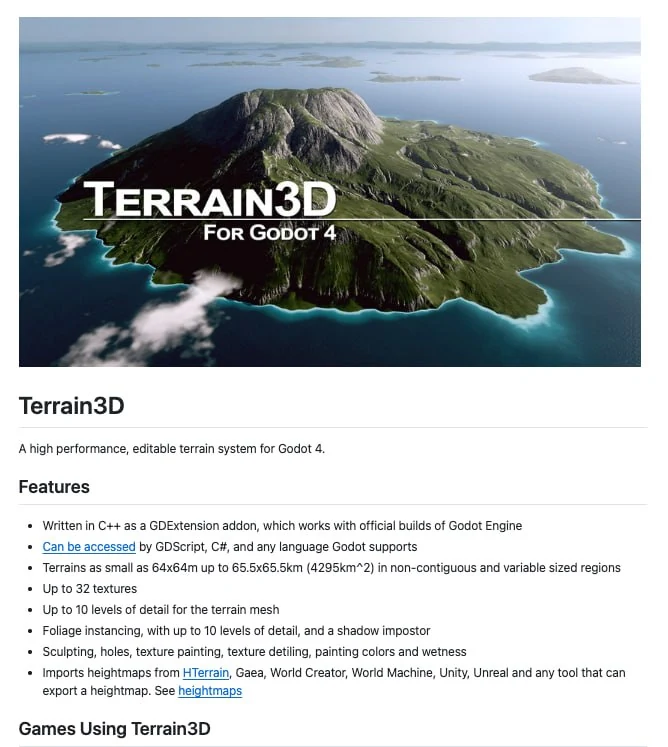
Terrain3D — creating huge landscapes in Godot. You can sculpt mountains, paint the surface, import heightmaps, and add vegetation with different levels of detail.
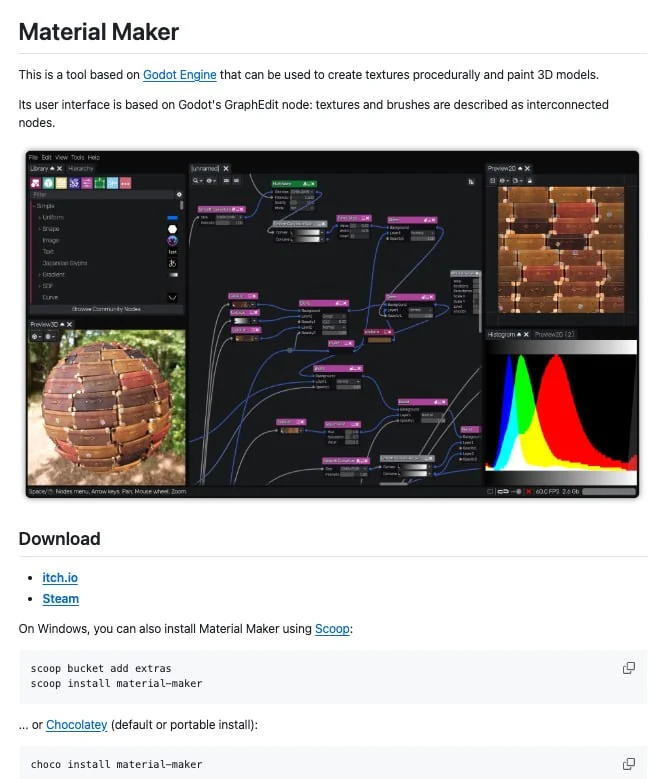
Material Maker — creating procedural textures and painting directly on 3D models. Materials are assembled with visual nodes, so you do not need to create every texture from scratch.
Effekseer — creating particle effects for explosions, magic, combat scenes, and environments. Effects can be exported as 2D animations or integrated into a game engine as 3D effects.
Voxel Tools for Godot — creating worlds where players can dig the ground and destroy the environment. Caves, tunnels, overhangs, and terrain streaming as the world is explored are supported.
Recast Navigation — a navigation system for enemies and NPCs. It allows building navigation meshes, calculating routes, and simulating crowd movement with collision avoidance.
ozz-animation — loading, playing, and blending character animations. The library is performance-oriented and helps implement smooth motion in a custom engine.
The Forge — if you are building your own game engine, this project provides cross-platform graphics infrastructure, resource loading, and animation systems. You do not have to develop everything from scratch.
meshoptimizer — optimizing, simplifying, and compressing 3D meshes. It helps reduce model size and improve rendering performance, especially when working with complex objects.
FastNoise2 — creating procedural landscapes and texture generators. It lets you combine different noise types in a visual node editor and then load the resulting settings into a game.
Why it matters
AnalysisThese repositories provide ready-made modules for physics, terrain, textures, animation, and optimization, making it easier for AI agents to assemble game prototypes without building core systems from scratch.
Discuss in community
Share your questions and insights with developers
Related in Ecosystem
Practical guides, core terminology, and agent skills
Jev and System One AI: A Complete Practical Guide to the Decision Model from TypeSafe
A deep engineering breakdown of the flagship Jev model: System One architecture versus LLMs, Choice/Score/Noul primitives, request parallelism, confidence mathematics, video use cases, code, and an overview of local open-weight alternatives (Laya, GLiNER2.5, CLM-8B).
Open-source method enables 6K image generation for Qwen Image, Ideogram, and Flux
A new open-source method supports creating images at very high resolutions, up to 6K, across several popular generation models.
10 GitHub repositories that will help you become an AI engineer in 90 days
Becoming an AI engineer today isn't all about models and prompts. Most of the real work is built around agents, RAG systems, orchestration, vector databases, and AI infrastructure.
AI Agents (Autonomous Agents)
Software systems based on LLMs that can autonomously perceive the state of the environment, decompose complex goals, invoke external tools, and iteratively correct their own mistakes.